Bhaskar Samineni
TL;DR
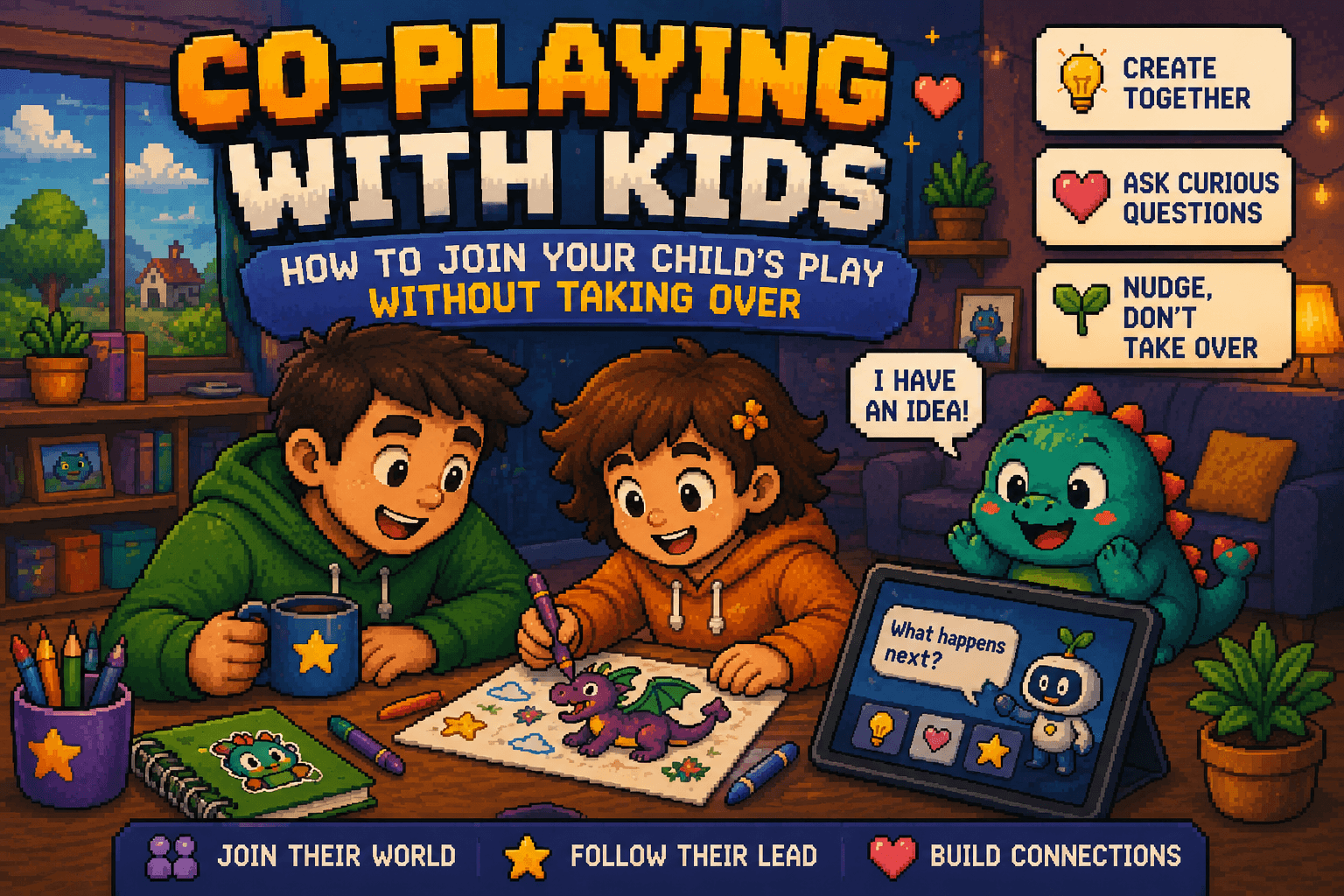
Co-playing does not mean teaching your child how to play.
It means entering their world, following their lead, and adding just enough to keep the play moving.
A good co-player:
asks before joining,
plays a role instead of becoming the director,
asks curious questions,
gives ideas without deciding the answer,
and knows when to step back.
The goal is not to make the game better. It is to help the child take their idea further.
What co-play looks like in practice
Your child is drawing a creature with six legs.
You could say:
“Animals normally have four legs.”
Or you could say:
“What can this creature do with six legs?”
The first response corrects the idea. The second one enters it.
That small difference is at the heart of co-play.
Children often invite adults into play because they want attention, connection, or someone to build the idea with. But adults naturally move toward helping: fixing the tower, improving the drawing, explaining the rules, or suggesting the “right” next step.
The intention is good. The result can be that the child slowly stops leading.
Co-play works best when the parent joins as a participant, not a project manager.
Why playing together matters
Play gives children room to make choices, test ideas, solve problems, negotiate, and express themselves.
Playing with a parent adds something different: a responsive partner.
Researchers sometimes call this kind of back-and-forth interaction “serve and return.” The child does or says something, the adult notices and responds, and the child takes the interaction forward again. These exchanges support communication, relationships, and learning. Harvard Center on Developing Child
The same idea applies to digital play. The American Academy of Pediatrics recommends exploring games, apps, and videos together, partly because it helps parents understand what their child enjoys and creates opportunities for conversation. HealthyChildren.org
But the value comes from the exchange—not simply from sitting beside the child.
The easiest way to take over
Adults tend to take over in four ways.
1. Solving too quickly
The tower leans, so you straighten it.
The child cannot find a color, so you choose one.
The story gets stuck, so you finish it.
Each intervention saves time, but removes a small decision from the child.
Try waiting a little longer than feels natural.
2. Turning play into a lesson
A child counts three blocks, and the parent starts testing multiplication.
A child draws a moon, and the parent begins explaining the solar system.
Learning can happen during play, but the child should not feel that every game is secretly homework.
3. Asking questions with correct answers
Questions such as “What color is a frog?” or “What does a doctor do?” test what the child already knows.
Questions such as “What kind of frog would live here?” or “What is unusual about this doctor?” help the child create.
4. Praising the result too quickly
“Beautiful.”
“Perfect.”
“You’re so talented.”
These sound supportive, but they can end the conversation.
Try noticing the process instead:
“You changed that part three times.”
“I did not expect the story to go there.”
“You used the same shape in two different ways.”
These responses show that you were paying attention.
Five ways to co-play without taking over
1. Ask permission to enter
Children may want you to play, watch, help, or simply stay nearby.
Try:
“Can I join?”
“Should I play a character?”
“Do you want an idea, or do you want to work it out?”
That final question is especially useful. It allows the child to decide what kind of help they need.
2. Let the child explain the world
Do not begin by asking what the game is supposed to be.
Ask what is already true inside it.
“Who lives here?”
“What can this machine do?”
“What happened just before this scene?”
“Is there a rule I should know?”
When children explain their play, they clarify their own thinking—and give you a role to play.
3. Add, but do not redirect
A useful contribution builds on the child’s idea.
Child:
“This is a hotel for dragons.”
Taking over:
“Let’s make it a dragon school instead.”
Co-playing:
“A very tired dragon has arrived. What kind of room would it need?”
You have added energy without changing ownership.
This is similar to improvisation: accept what is already there, then add one small possibility.
4. Offer choices, not answers
When a child is stuck, avoid deciding for them.
Instead of:
“Put the door here.”
Try:
“Would you rather hide the door, make it enormous, or put it somewhere unexpected?”
Instead of:
“The character should escape.”
Try:
“Could they escape, ask for help, or turn the problem into something useful?”
A few options can create momentum while keeping the final decision with the child.
5. Leave before you become necessary
Good co-play does not always need to last until the game ends.
Once the child has momentum, say:
“You seem to know where this is going. Call me when you want another character.”
Stepping away communicates trust.
Questions that keep play moving
The best questions do not have one correct answer.
To develop an idea
What else could this become?
What is the strangest part?
What would make it more surprising?
What is missing from this world?
What could happen next?
When the child is stuck
Which part are you unsure about?
Do you want a clue, a choice, or another minute?
What have you already tried?
Could you change one rule?
What would the character do?
To encourage reflection
Which part are you most proud of?
What changed from your first idea?
Which decision was hardest?
What would you add with ten more minutes?
Would you make the same choices again?
NAEYC recommends using calm questions to help children think through situations rather than immediately supplying the response for them. The same principle works well during creative play. NAEYC
Co-playing at different ages
With younger children, you may need to take a visible role: voice a character, hand over materials, or copy an action they begin.
With older children, co-play can feel more like collaboration. They may want you to contribute one idea, respond to their creation, or attempt the same challenge beside them.
As children grow, the parent’s role often shifts:
helper → character → collaborator → audience
There is no fixed age for each stage. Follow the amount of independence your child is asking for.
How to co-play with digital games
Digital play can be shared without the parent controlling the screen.
Ask the child to be your guide:
“Show me what you are making.”
“What choices did the game give you?”
“What did you decide that the game did not decide for you?”
“Can we each try the same challenge differently?”
You can also divide the roles.
One person draws while the other invents the character’s backstory.
One person creates a rhythm while the other names the song.
One person takes a photograph while the other creates a caption.
The goal is not to supervise every tap. It is to understand the child’s thinking and occasionally become part of it.
How Taroo supports co-play
Taroo is built around creative games that children can play independently, but parents can easily join.
A parent might help invent a character, respond to a drawing, contribute a sound, act out one side of a conversation, or attempt the same creative challenge alongside the child. Because Taroo games focus on making rather than scoring one correct answer, the parent does not need to know more than the child to participate.
AI plays a similar role.
It can introduce a challenge, offer feedback, or suggest another direction when the child needs it. When the child already has momentum, it can stay quiet. AI helps the play continue, while the child remains in charge of what gets made.
Parents can also see what their child created and receive insights that make future co-play easier. Rather than asking the broad question, “What did you do today?”, a parent can begin with something specific:
“I saw the character you made. Why did you give it that power?”
“You tried a few different versions. What made you choose this one?”
“Could we make another ending together?”
Taroo also allows parents to create challenges for their children. These can become shared family games: inventing two versions of the same creature, photographing unusual shapes around the house, creating a rhythm together, or building a story one line at a time.
The parent brings attention, curiosity, and shared history. AI brings timely support. The child still brings the most important part: the direction.
A simple co-play routine
You do not need to turn co-play into another scheduled class.
Try this once or twice a week:
Let your child choose the game.
Ask what role they want you to play.
Follow their idea for ten minutes.
Ask one question that opens a new possibility.
End by asking what they want to make next.
Ten attentive minutes can be more meaningful than an hour spent giving instructions.
The takeaway
Joining a child’s play is not about improving what they make.
It is about showing them that their ideas are worth entering.
Follow before you lead. Ask before you help. Add without redirecting. Step back when the idea begins moving on its own.
The best co-play leaves the child with more confidence, more possibilities, and a creation that still feels entirely theirs.
FAQs
What is co-play?
Co-play means an adult and child participating in play together. The adult follows the child’s interests, contributes to the activity, and supports the play without controlling it.
How is co-play different from teaching?
Teaching usually has a skill or outcome chosen by the adult. In co-play, the child’s idea leads. Learning may still happen, but it grows from the play rather than replacing it.
What should I do when my child gets stuck?
Wait first. Then ask whether they want a clue, a few options, or more time. Give the smallest amount of help that allows them to continue.
Can digital play count as co-play?
Yes. Parents can play games, use creative apps, discuss choices, make something together, or let the child teach them how the experience works. Shared digital play can also help parents understand their child’s interests. HealthyChildren.org
How does Taroo help parents co-play?
Taroo’s creative games make it easy for parents to join through drawing, storytelling, music, photography, observation, and shared challenges. Parents can see their child’s creations, receive useful insights, and use those details to begin more meaningful play and conversation.
You may also like
5 Best Sago Mini World Alternatives for Creative Play and Learning
Why Games Are a Great Starting Point for Storytelling, Music, and Drawing

Best Writing Games for Kids Ages 6–10: Fun Ways to Start Stories, Sentences, and Ideas
