Arjun Rakesh
TL;DR
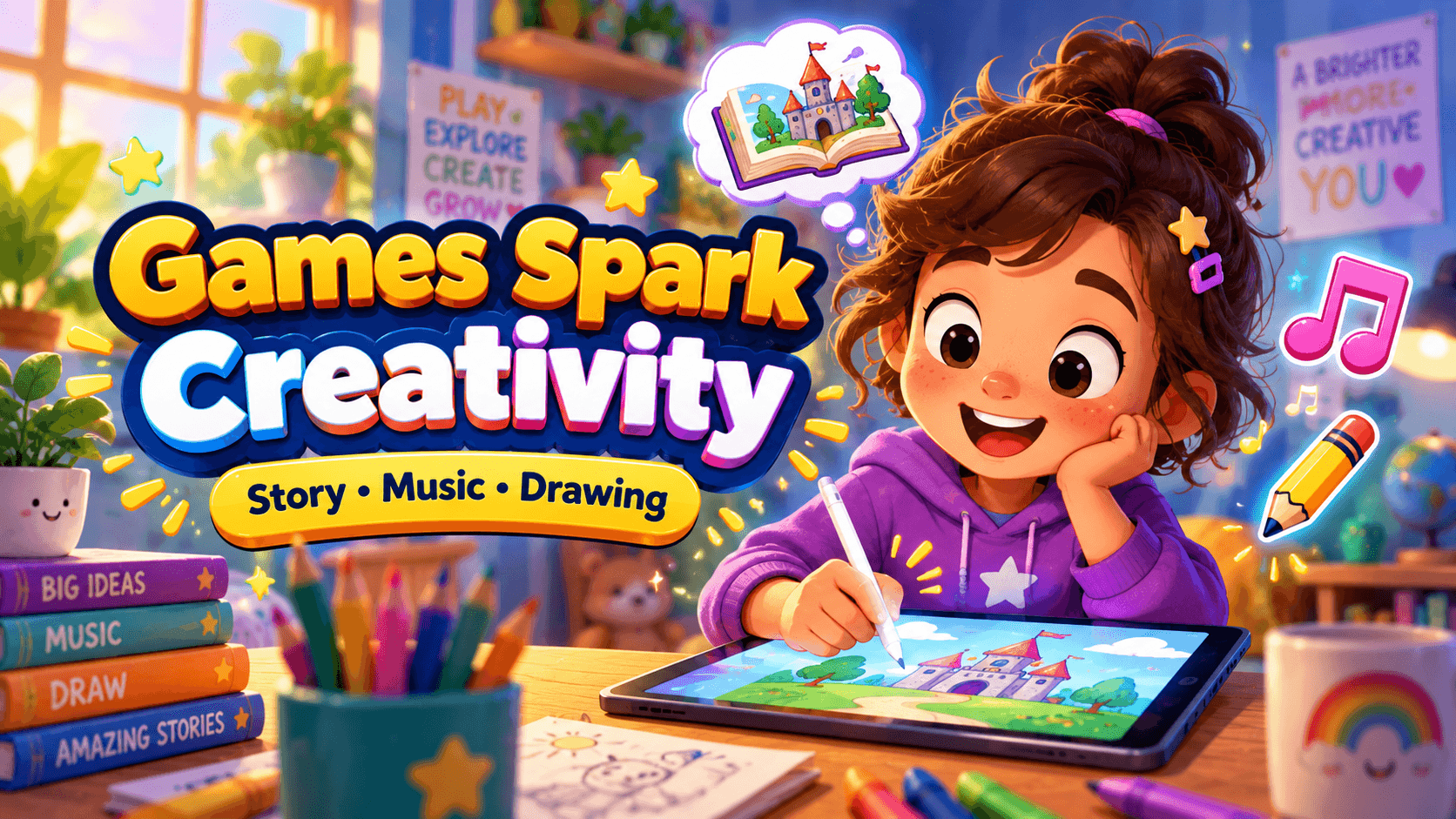
Games can be a powerful stepping stone into creative interests because they make starting feel easier. A child may not sit down and decide, “I want to practice storytelling,” “I want to learn music,” or “I want to improve my drawing.” But they may happily describe a funny picture, add the next line to a story, tap a rhythm, finish a doodle, or go on a creative quest. For kids ages 6–10, games work best when they do not replace creativity with rewards. They work when they help children make something of their own.
Direct answer
Games are a great catalyst for creative interests because they lower the pressure of beginning. Instead of asking a child to write a story, compose music, or draw something from scratch, a good creative game gives them a small prompt, a playful goal, and enough freedom to make choices. In Taroo, games like Caption Lab, Pass the Pen, Rhythm Pad, Doodle Master, and Snap Trail introduce kids to storytelling, music, drawing, and observation through short creative quests.
Parents often think interests begin with a big declaration.
“My child loves music.”
“My child is into drawing.”
“My child is a storyteller.”
But for kids ages 6–10, interests often begin much smaller than that.
A child laughs at a picture and invents a caption. They add one strange sentence to a story. They tap a beat on the table. They draw a creature because the prompt made them curious. They take a photo of something ordinary and suddenly notice it differently.
That is how many creative interests begin: not as a serious commitment, but as a playful doorway.
This is why games matter. A good game gives children a reason to start before they know whether they are “good” at the thing. It lets them try storytelling before writing feels like school. It lets them try rhythm before music feels like lessons. It lets them try drawing before art feels like performance.
The American Academy of Pediatrics describes play as important for children’s development, including language, imagination, social-emotional skills, and self-regulation. It also emphasizes that play works best when children retain agency and are not only following adult-controlled rules. That is the sweet spot for creative games: enough structure to begin, enough freedom for the child’s idea to matter.
Games make the first step smaller
The hardest part of creativity is often not talent. It is starting.
“Write a story” can feel huge. “Draw something” can feel too open. “Make music” can sound like something only musicians do. Even creative children can freeze when the invitation is too broad.
A game solves that by shrinking the beginning.
Caption Lab does not ask a child to write a full story from nothing. It starts with a picture. The child notices what is happening, imagines what might be going on, and turns that thought into language. That is storytelling practice, but it does not feel like a writing assignment.
Pass the Pen makes the beginning even less intimidating because the child does not have to carry the whole story alone. They only need to add the next piece. One turn becomes another. The story grows because each child has a manageable role in moving it forward.
This is what games do well. They turn “create something” into “try this next move.” For kids ages 6–10, that difference is enormous.
A child who says “I don’t know what to write” may still know what happens next when a dragon walks into a school cafeteria. A child who says “I can’t draw” may still add eyes, wings, or a ridiculous hat to a half-finished creature. The game gives them a start before self-judgment takes over.
Games help children discover what they enjoy making
Parents often look for signs of talent. But at this age, a better thing to watch is return behavior.
What does the child keep coming back to?
Some children return to characters. Some return to sound. Some return to visual details. Some return to movement, jokes, pretend worlds, or little systems they invent. A good creative game lets those preferences surface naturally.
In Taroo, a child who keeps enjoying Caption Lab or Pass the Pen may be showing an early interest in storytelling. Not because they sat down to write a polished story, but because they enjoy imagining scenes, adding twists, and explaining what happens.
A child who keeps returning to Rhythm Pad may be showing curiosity about rhythm and sound. They may not be ready for formal lessons, notation, or an instrument yet. But they are beginning to feel that music is something they can shape.
A child who likes Doodle Master may be drawn to visual expression. They may enjoy completing an image, adding details, or seeing how a small prompt can become something personal.
That is why games are useful as stepping stones. They let children sample creative identities without the pressure of becoming “a writer,” “a musician,” or “an artist” too early.
Storytelling begins before writing
One of the biggest mistakes adults make is treating storytelling and writing as the same thing.
They are connected, but they are not identical.
Many kids can tell stories long before they can comfortably write them. Their imagination may move faster than their handwriting, spelling, typing, or sentence structure. So when storytelling is introduced only through writing, the child may feel blocked before the creative part even begins.
Games can separate the story muscle from the writing burden.
Caption Lab starts with observation. A child looks closely, notices details, and imagines what might be happening. That is the beginning of narrative thinking. Pass the Pen adds sequence. The child has to listen to what came before and decide what happens next. That is the beginning of plot.
Neither game requires a child to produce a perfect paragraph. They practice the creative actions underneath writing: noticing, imagining, sequencing, explaining, and revising an idea.
That matters because a child who learns to enjoy story-making is more likely to see writing as a way to express something, not just a task to complete.
Music begins before music lessons
Music can also feel too formal too quickly.
Lessons are valuable, but the first relationship a child has with music does not need to begin with correctness. It can begin with rhythm, repetition, listening, and play.
Rhythm Pad gives kids that kind of entry point. A child can tap, copy, change, and create a beat without needing to read notes or understand theory. They can hear that a pattern feels different when it speeds up, slows down, repeats, or changes.
That is not professional music-making. It is something more basic and age-appropriate: the feeling that sound can be played with.
For kids ages 6–10, that first feeling matters. A child who enjoys making rhythms may later become more curious about drums, piano, dance, singing, composition, or sound design. But the game does not need to force that path. It only needs to open the door.
A music game works when it gets a child to say, “Listen to what I made.”
That is the moment music becomes active.
Drawing begins before “being good at art”
Drawing is another place where children can become self-conscious early.
By ages 6–10, many kids begin comparing their drawings with other children’s drawings, adult examples, or polished images they see online. Some decide very quickly that they are “bad at drawing,” even though what they really mean is, “My hand cannot yet make the thing in my head.”
A game like Doodle Master can help because it makes drawing feel like a challenge, not a judgment.
The goal is not to create perfect art. The goal is to respond to a prompt, add an idea, and make a choice. A child might complete an image, invent a creature, add details to a scene, or turn a simple shape into something unexpected.
This aligns with the broader idea of process-focused creativity. NAEYC distinguishes between product-focused art, where children copy a predetermined result, and process-focused art, where children explore, make choices, and express their own ideas. Doodle Master belongs closer to that second spirit. It gives structure, but the child’s choices still matter.
A good drawing game should not make a child ask, “Is this good?”
It should make them wonder, “What else can I add?”
Games turn curiosity into practice
The best creative games are not only fun once. They create a loop.
Try something. See what happened. Change it. Try again.
That loop is how practice begins without feeling like practice.
A child adds a funny line in Pass the Pen and sees the story change. They try a different rhythm in Rhythm Pad and hear the mood shift. They add one detail in Doodle Master and the drawing becomes more alive. They notice something in Caption Lab and suddenly the picture has a story.
Those tiny loops matter because they build creative confidence. The child learns that their choices have effects. Their ideas can change the outcome. Their contribution is visible.
Harvard’s Center on the Developing Child describes games and playful activities as ways children can practice skills like attention, working memory, and self-control. Creative games add another layer: they help children practice turning attention into expression.
That is the bridge from play to interest.
Why Taroo uses games for creative growth
Taroo is built around the belief that children need more chances to make things, not just consume content.
That is why the games are short, playful, and open-ended. They are not trying to turn a 7-year-old into a novelist, a composer, or a trained artist. They are trying to help that child take the first creative step often enough that the step becomes familiar.
Caption Lab helps a child enter storytelling through observation. Pass the Pen makes story-building social and less intimidating. Rhythm Pad lets music begin with beat and play. Doodle Master makes drawing feel like a creative challenge instead of a blank-page test. Snap Trail helps children notice the real world and turn observation into creative material.
Together, these games show a simple idea: creative interests do not always begin with instruction. Sometimes they begin with a spark.
A prompt.
A rhythm.
A picture.
A turn.
A small challenge that makes the child want to keep going.
The takeaway
Games are not the opposite of serious creative growth.
For kids ages 6–10, games can be the way serious creative growth begins.
A good game lowers the pressure, gives a child a starting point, and lets them make choices. It helps a child try storytelling before writing feels easy, try music before lessons feel natural, and try drawing before they believe they are “good” at art.
That is why creative games matter.
They do not need to do everything. They only need to help children begin.
And once a child begins often enough, something changes. They stop seeing storytelling, music, or drawing as activities other people are good at. They start seeing them as things they can try, shape, and make their own.
That is how an interest starts.
Frequently asked questions
Can games help kids become more creative?
Yes, games can support creativity when they ask children to make choices, solve problems, imagine possibilities, and create something of their own. The most useful creative games are active, not passive.
How do games help with storytelling?
Storytelling games help kids practice noticing details, imagining characters, sequencing events, and explaining what happens next. In Taroo, Caption Lab and Pass the Pen help children build stories without needing to start from a blank page.
How do games introduce kids to music?
Music games introduce children to rhythm, listening, pattern, and sound-making in a playful way. In Taroo, Rhythm Pad gives kids a simple way to tap, change, and create beats before music feels formal.
How do games help kids start drawing?
Drawing games reduce blank-page pressure by giving children a prompt or challenge. In Taroo, Doodle Master helps kids add details, complete ideas, and express themselves visually without focusing on perfect results.
Are creative games a replacement for classes?
No. Creative games are not a replacement for art teachers, music lessons, writing instruction, or real-world creative experiences. They are a low-pressure way to help children begin, practice, and build confidence between those bigger experiences.
Is Taroo a learning game?
Taroo is a creative quest app for kids ages 6–10. It is not built around quizzes or memorization. It helps children practice storytelling, drawing, rhythm, observation, and expression through playful creative games.
You may also like

Best Writing Games for Kids Ages 6–10: Fun Ways to Start Stories, Sentences, and Ideas

Best Music Games for Kids Ages 6–10: Fun Ways to Explore Rhythm, Sound, and Creativity

6 Best Pok Pok Alternatives for Creative Play and Learning
