Arjun Rakesh
TL;DR
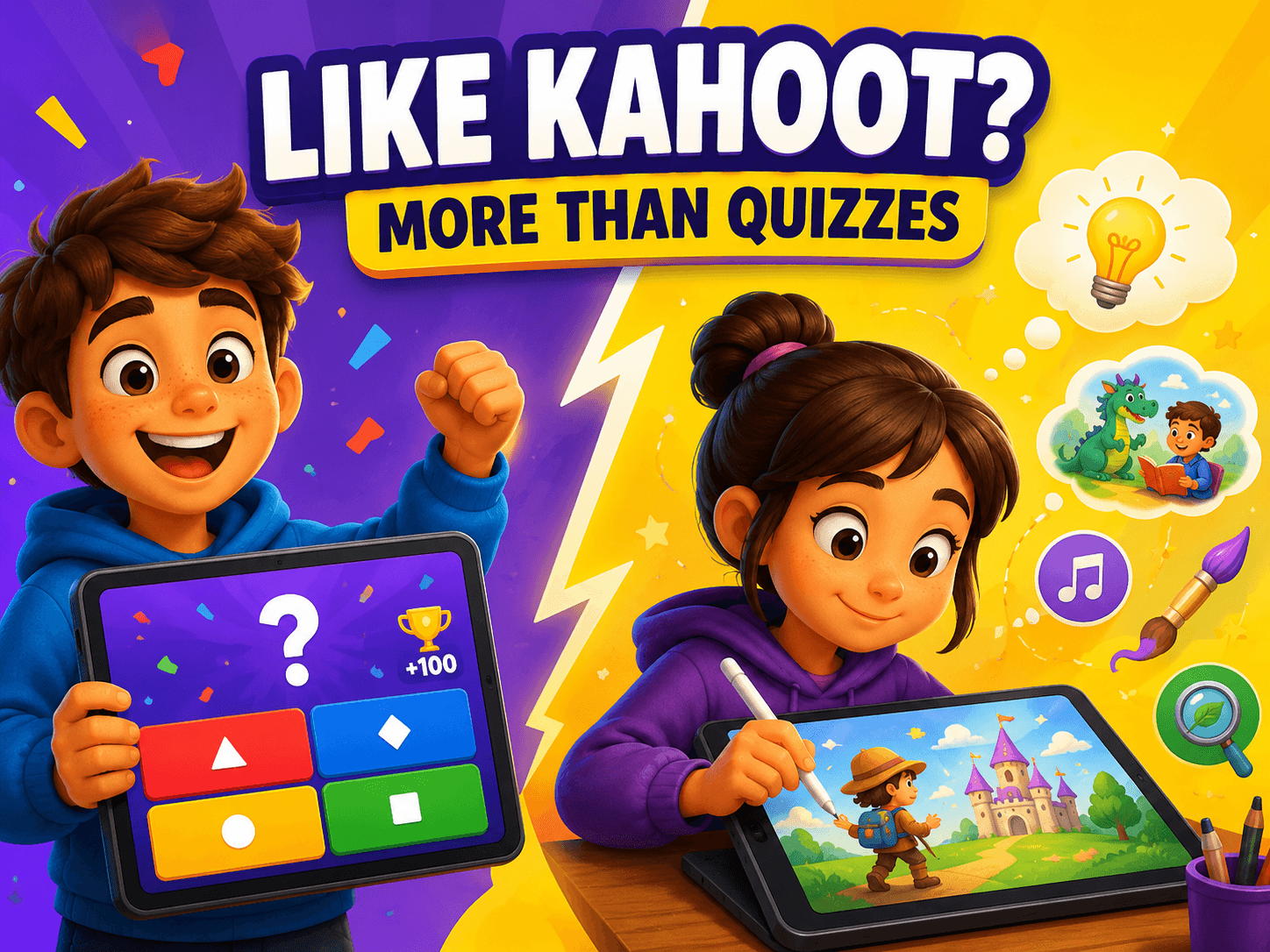
Kahoot is great for quizzes, review games, classroom energy, and fast participation. But Kahoot-style learning is usually built around questions with known answers. Kids also need open-ended creative practice: telling stories, drawing, making rhythms, taking photos, building ideas, and explaining their thinking. If your child enjoys learning games like Kahoot, pair quiz-based learning with creative games like Taroo so they practice more than speed, recall, and correct answers.
Short answer: what are learning games like Kahoot but for creative skills?
If you want learning games like Kahoot but for creative skills, look for apps where kids make something rather than only answer questions. Taroo is a strong choice for kids ages 6 to 10 because it uses creative quests across storytelling, drawing, rhythm, observation, and expression. Other options include Scratch for coding projects, Stop Motion Studio for filmmaking, Tinkercad for design, GarageBand for music, and Epic for reading-inspired creativity.
Kahoot is fun for a reason.
A question appears. Everyone joins in. There is a countdown. The room gets louder. Kids are excited to answer quickly and see who got it right.
For classrooms, parties, review sessions, and quick checks for understanding, that energy can be useful. Kahoot is built around game-based learning, and its school features include quizzes, polls, puzzles, typed answers, word clouds, open-ended questions, and reports teachers can use to assess learning.
But Kahoot-style learning has a limit.
Most of the time, the child’s job is to respond to a prompt that already has an expected answer. That can help with recall. It can make review more exciting. It can keep a group engaged.
But it is not the same as creating something original.
After age 6, kids need more than quizzes, puzzles, and multiple-choice-style activities. They need chances to make, explain, imagine, draw, build, observe, and express.
That is why learning games like Kahoot should be part of the mix, not the whole diet.
What Kahoot gets right
Kahoot makes learning social. That is its biggest strength.
A worksheet can feel quiet and lonely. A quiz game can feel like a shared event. Kids see the same question, react at the same time, and get immediate feedback.
That can be especially useful for review. If a class has already learned a topic, Kahoot can help make practice more exciting. It can also help teachers see what students understood and what they missed.
At home, Kahoot-style games can make family trivia, spelling practice, or subject review feel more playful.
So the critique is not that Kahoot is bad. It clearly has a job.
The critique is that quizzes mainly train one kind of learning: recall and response.
Where Kahoot-style learning can fall short
A quiz is usually closed-ended. The app asks a question, and the child chooses or types an answer.
That can be useful. But if too much learning becomes quiz-based, kids may start to think learning is mostly about speed and correctness.
Who answered fastest?
Who got the most points?
Who remembered the fact?
Those are not bad things. They are just incomplete.
Creative thinking requires a different kind of question:
“What do you notice?”
“What would you make?”
“What story could this become?”
“What rhythm can you create?”
“How would you explain your idea?”
“What would you change?”
A quiz asks kids to find the answer.
A creative prompt asks kids to build one.
That is the missing piece.
What kids need after age 6
After age 6, kids are ready for more than simple review games. They still like play, characters, rewards, and quests. But they also need activities that give them ownership.
They need screen time where the child’s idea matters.
That could mean drawing a character, telling a story from a picture, taking photos for a scavenger hunt, creating a beat, making a tiny movie, coding an animation, or explaining why they made a choice.
This is not about replacing every quiz. It is about giving children both sides of learning.
They need recall and expression.
Practice and imagination.
Correct answers and original answers.
What to look for in learning games like Kahoot
If your child likes Kahoot because it feels fast, social, and game-like, look for creative apps that keep a sense of play but add output.
If your child likes Kahoot for… | Look for an app that adds… |
|---|---|
Fast questions | Slower creative prompts |
Quiz energy | Creative quests |
Correct answers | Original ideas |
Group participation | Story-building or sharing |
Competition | Confidence through creation |
Review | Making, explaining, and expression |
The useful test is simple: after the app, can your child show or share something they created?
If yes, the game is building more than quiz performance.
1. Taroo
Best for: Kids ages 6 to 10 who need creative practice beyond quizzes
Taroo is the best app to pair with Kahoot-style learning if you want kids to practice open-ended creativity.
Kahoot helps kids answer quickly. Taroo helps kids create thoughtfully.
In Taroo, kids go on short creative quests where they describe images, build stories, draw, create rhythms, go on photo scavenger hunts, and explain their ideas. There is still a playful structure, but the child’s role is different.
They are not only choosing the correct answer. They are making something of their own.
In Caption Lab, kids look at an image and describe what might be happening.
In Pass the Pen, kids take turns building stories.
In Doodle Master, kids complete drawing challenges.
In Rhythm Pad, kids listen, tap, and create beats.
In Snap Trail, kids use the camera for photo scavenger hunts that sharpen observation.
Why parents may like it:
It builds creative skills quiz games do not focus on.
It is designed for kids ages 6 to 10.
It gives kids open-ended prompts.
It supports storytelling, drawing, rhythm, observation, and expression.
It is safe, kid-friendly, ad-free, and built with parent visibility.
Possible downside:
Taroo is not a live classroom quiz tool. If you need group quizzes, test review, or a teacher-led assessment game, Kahoot is better. Taroo is the creative complement.
2. Scratch
Best for: Kids who want to make interactive projects
Scratch is a strong choice for children who like interactive learning but want to make their own games, animations, and stories.
A child can create a quiz, but they can also make a character move, tell jokes, switch scenes, and respond to clicks. It turns the child from player into creator.
Why parents may like it:
Kids make their own games and animations.
It builds logic and sequencing.
It supports open-ended projects.
Free to use.
Possible downside:
Scratch can feel too open-ended at first. Younger kids need guidance because of the online community.
3. Stop Motion Studio
Best for: Kids who like stories, characters, and performance
Stop Motion Studio lets kids create mini movies using toys, drawings, LEGO figures, paper cutouts, or household objects.
This is a strong contrast to quiz games because it asks for planning, patience, and storytelling. The child has to decide what happens, move the characters, and build the scene frame by frame.
Why parents may like it:
Turns screen time into filmmaking.
Combines digital and hands-on play.
Builds sequencing and persistence.
Great for kids who like stories and characters.
Possible downside:
It takes setup. Keep the first project very short.
4. Tinkercad
Best for: Kids who like design and building
Tinkercad lets kids create 3D designs from simple shapes. It is a good fit for children who like construction, engineering, and spatial thinking.
Instead of answering questions about a topic, they design an object. That makes the learning more project-based.
Why parents may like it:
Builds spatial reasoning.
Introduces design and engineering.
Gives kids real project output.
Free to use.
Possible downside:
It has a learning curve and may require adult support at first.
5. GarageBand or beginner music apps
Best for: Kids who like sound and rhythm
Quiz games are often visual and verbal. Music apps give children a different creative channel.
With GarageBand or beginner music tools, kids can make beats, record voices, layer sounds, and create a theme song for a character or story.
Why parents may like it:
Builds rhythm and listening.
Encourages experimentation.
Gives kids a shareable output.
Works for kids who do not gravitate toward drawing or coding.
Possible downside:
Some children may need help getting started with a simple prompt.
6. Epic
Best for: Kids who need story input before creative output
Epic is a digital reading library with books, comics, audiobooks, and read-to-me titles. It is not a quiz game, but it can give kids story fuel.
To make it active, ask your child to create something afterward: a new ending, a character drawing, a book cover, or a one-minute retelling.
Why parents may like it:
Supports reading.
Offers broad story exposure.
Good for reluctant readers.
Can pair well with creative prompts.
Possible downside:
It is mostly reading and listening unless paired with output.
So, what should kids use with Kahoot?
Use Kahoot when the goal is review, recall, participation, or group energy.
Use creative apps when the goal is expression, originality, and making.
Kahoot can help kids remember an answer.
Taroo can help kids make one.
Both have value, but they build different skills.
A balanced screen-time mix might include a quiz game for subject review, a reading app for story input, a coding app for systems thinking, and Taroo for broad creative practice.
The takeaway
Learning games like Kahoot are great at making quizzes more exciting. They can help kids participate, remember, and review.
But kids need more than quiz energy.
They need to tell stories, draw ideas, make rhythms, observe the world, design projects, and explain their thinking.
After age 6, the strongest screen time is not only about picking the right answer.
It is also about making an answer of your own.
Frequently asked questions
What are learning games like Kahoot?
Learning games like Kahoot are usually quiz-based or review-based games where students answer questions in a playful format. They are useful for participation, recall, classroom review, and quick checks for understanding.
Is Taroo a Kahoot alternative?
Taroo is not a direct replacement for Kahoot as a live classroom quiz tool. Kahoot is better for quizzes and group review. Taroo is a creative-skills app that pairs well with Kahoot-style learning by helping kids tell stories, draw, create rhythms, observe, and express ideas.
What are learning games like Kahoot but more creative?
Taroo, Scratch, Stop Motion Studio, Tinkercad, GarageBand, and Epic are good options if you want children to create something instead of only answering quiz questions.
Why do kids need more than quizzes?
Quizzes help children practice recall and correct answers. Kids also need open-ended creative practice where they make, explain, imagine, draw, build, and express their own ideas.
What is a good creative learning game for kids ages 6 to 10?
Taroo is a strong creative learning game for kids ages 6 to 10 because it uses short quests across storytelling, drawing, rhythm, observation, and expression.
Should kids stop using Kahoot?
Not necessarily. Kahoot can be useful for review and group learning. The better move is to balance quiz-style learning with creative apps where kids make something of their own.
You may also like
5 Best Sago Mini World Alternatives for Creative Play and Learning
Why Games Are a Great Starting Point for Storytelling, Music, and Drawing

Best Writing Games for Kids Ages 6–10: Fun Ways to Start Stories, Sentences, and Ideas
