Bhaskar Samineni
TL;DR:
A Stanford study found that children can dip, jump, and grow along very different creative paths.
Your child used to draw every day.
They filled pages with strange animals, imaginary machines, and stories that made little sense—but were completely their own.
Then something changed.
Now they stare at the page and say, “I don’t know what to make.” They erase more. They compare their work with other children’s. Ideas that once appeared effortlessly become harder to find.
Did they become less creative?
Maybe not.
Creativity does not always develop in a smooth upward line.
What Stanford researchers found

Researchers have long discussed a possible drop in creative thinking during middle childhood, sometimes called the “fourth-grade slump.”
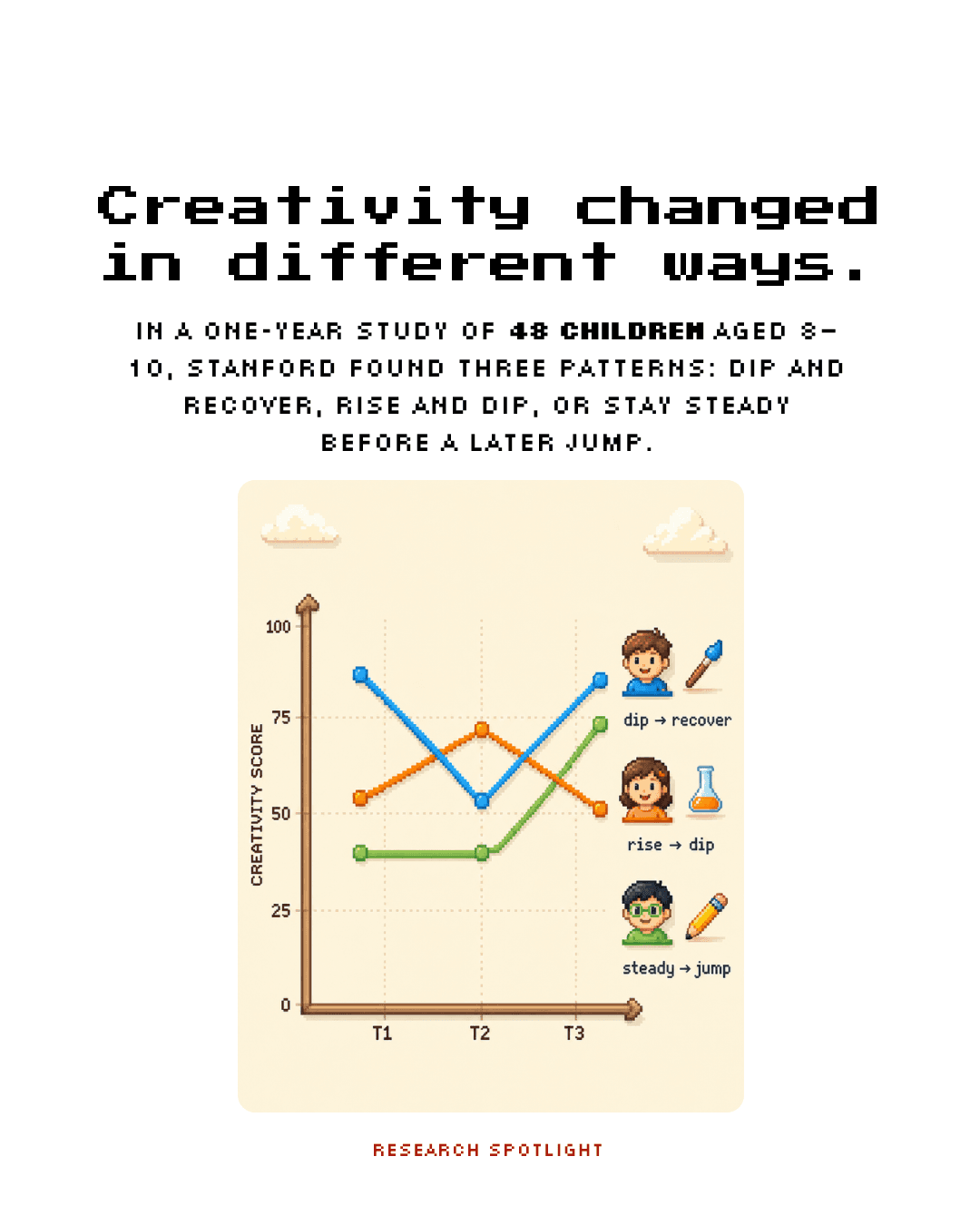
To understand what was really happening, a Stanford research team studied the creative development of 48 children—21 beginning third grade and 27 beginning fourth grade. Each child was assessed at three different points across one year, allowing researchers to estimate how creativity changed between roughly ages 8 and 10.
The children completed drawing-based creative-thinking tasks. They were shown incomplete figures and asked to transform them into unusual drawings and stories that other children might not think of.
But the researchers did something important: instead of assuming that children of the same age would follow the same pattern, they examined each child’s development over time.
They found three different creativity paths.
1. Dip, then recover
Some children’s creativity scores initially declined before increasing after they moved into the next grade.
2. Rise, then dip
Other children improved at first but experienced a decline later.
3. Stay steady, then jump
A third group showed little initial change before making a substantial creative leap.
Children of similar ages, attending similar grades, were moving along completely different creative timelines. The researchers concluded that children cannot be neatly grouped by age or grade because each child may be following their own trajectory.
A single creation cannot tell you where a child is heading
Parents often judge creativity through isolated outputs:
A drawing that looks less detailed than a classmate’s.
A story that ends after two sentences.
A rhythm that sounds repetitive.
A project abandoned halfway through.
But one creation only tells us what the child made in that moment.
A finished project is a photograph.
Creative development is a film.
A dip may mean that the child is becoming more self-conscious. They may be more aware of quality, worried about being wrong, or attempting something more difficult than before.
A plateau may simply mean that visible progress has not arrived yet.
Creativity can also move from one medium to another. A child who stops drawing may begin inventing games, telling elaborate stories, making jokes, building imaginary worlds, performing characters, taking photographs, or experimenting with rhythm.
They may not be becoming less creative.
Their creativity may be changing languages.
The problem: children do not always have somewhere to direct that creativity
Telling a child to “go be creative” rarely works.
Creative play often depends on several things arriving at the same time:
The child needs an idea.
The right materials need to be available.
An adult may need to set up the activity.
The task needs to feel interesting, but not overwhelming.
The child needs enough direction to begin without being told exactly what to make.
A blank page offers freedom, but it can also create paralysis.
At the other extreme, activities with one correct answer may keep children occupied without giving them a meaningful creative decision.
This makes it easy for creativity to become occasional: something children practise when inspiration strikes, when materials are available, or when a parent has planned an activity.
But children following different creative paths need something else: many opportunities, across many forms of creativity, available when they feel ready to explore.
Giving children more than one creative path
This is what Taroo is designed to provide.
Taroo contains different creative games across storytelling, speaking, drawing, music, photography, observation, and idea generation. A child can move from creating beats in Rhythm Pad, to experimenting visually in Doodle Master, to playing with ideas in Three Things.

They do not need to wait for a parent to gather supplies or invent an activity. They do not need to begin with an intimidating blank prompt.
Each game provides the inspiration needed to start: an interesting situation, image, character, sound, challenge, or creative constraint.
But the game does not decide the outcome.
The child still chooses what happens next, what sounds right, what looks interesting, which idea to develop, and when to try something different. AI can offer a nudge or introduce a possibility, but the child directs the creation. That is central to Taroo’s approach: structured creative projects in which AI assists without taking over.
This matters because different children—and even the same child on different days—may need different creative entry points.
One day, they may want to draw.
Another day, they may want to make music.
On another, they may have an opinion they want to turn into something funny, surprising, or thoughtful.
Instead of deciding that a child “is artistic” or “isn’t creative,” Taroo gives them enough different avenues to discover where their ideas naturally emerge.
And because these experiences happen repeatedly, parents can begin to notice patterns over time:
What does the child return to voluntarily?
Where do they persist after getting stuck?
Which types of prompts produce the most ideas?
Are they experimenting more confidently?
Are they discovering a creative language that adults had not noticed before?
The goal is not to label a child’s permanent creativity type. It is to give them enough opportunities for their path to reveal itself.
A dip is not always a decline.
A plateau is not always stagnation.
A child who struggles today may jump several months later.
Our job is not to decide too early who is creative. It is to give children enough inspiration, enough avenues, and enough freedom to discover how they create.
You may also like
5 Best Sago Mini World Alternatives for Creative Play and Learning
Why Games Are a Great Starting Point for Storytelling, Music, and Drawing

Best Writing Games for Kids Ages 6–10: Fun Ways to Start Stories, Sentences, and Ideas
