Arjun Rakesh
TL;DR
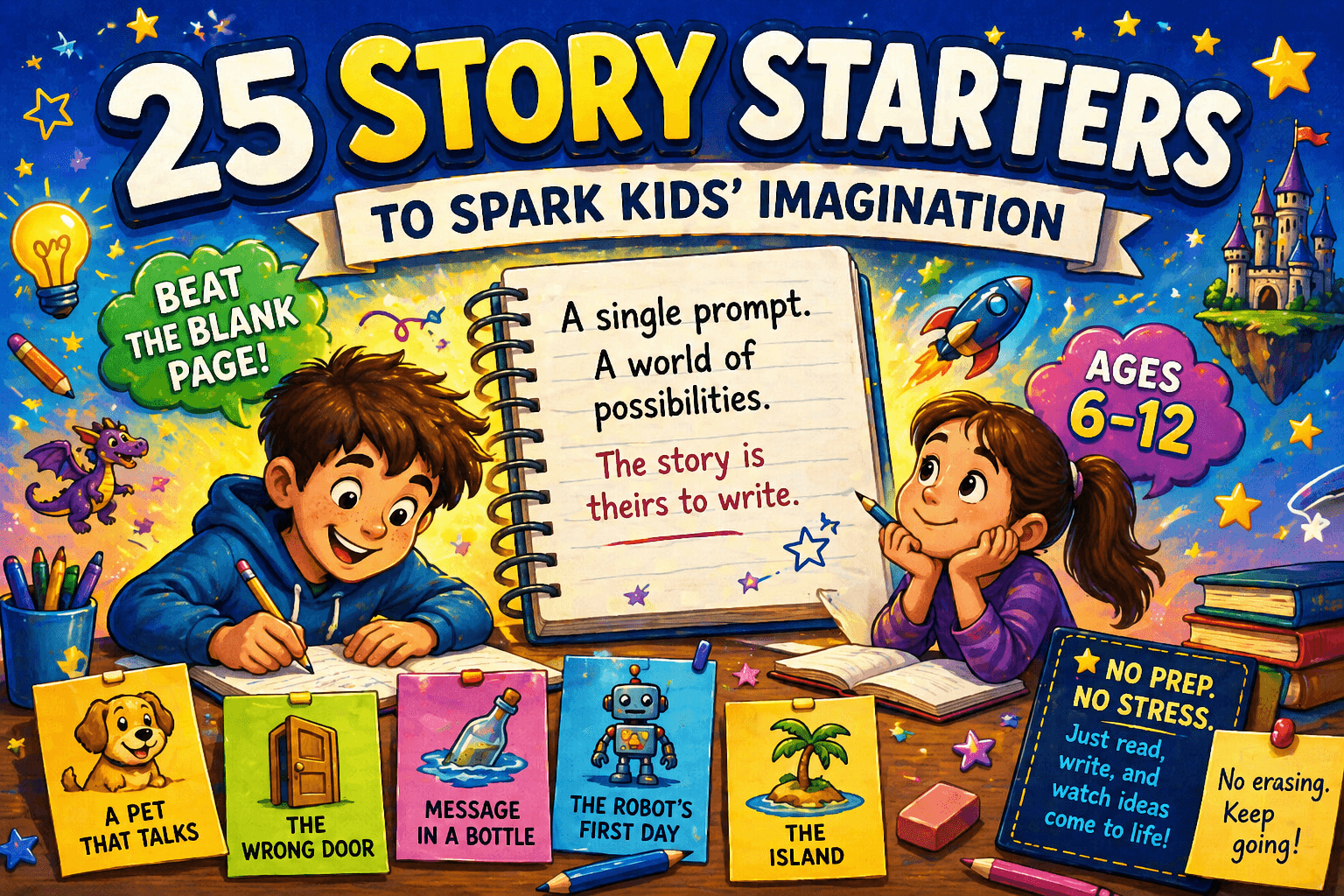
25 original story starters designed to cut through the blank-page freeze in under 5 minutes
Works for ages 6–12; prompts range from simple (“A Pet That Talks”) to more complex (“Two Truths and a Lie”)
No prep, no materials needed. Read one aloud, hand over a notebook, and step back
Includes guidance on how to extend a story if your child finishes too quickly
The only rule: no stopping to erase
Sometimes the hardest part of writing isn’t the writing, it’s actually the getting-started part. These 25 writing prompts for kids are built to cut through the “I don’t know what to write” stall in under five minutes. Most work for ages 6–12, and a few have produced stories that ran longer than anyone expected.
Read one aloud, hand your child a notebook, and step back. The only rule: no stopping to erase.
1. The Wrong Door: Your character opens a familiar door and finds it leads somewhere completely different. Where does it go?
2. The Last Human: Everyone on Earth has vanished except your character. They wake up at home, totally alone. What’s their first move?
3. A Pet That Talks: Your dog has always been able to talk. They just chose today to start. What do they say and why now?
4. The Map in the Attic: You find an old map in your grandparents’ attic showing a location three miles away you’ve never heard of. What do you do and where does it take you?
5. Swap Day: You wake up in your best friend’s body. They wake up in yours. You both have exactly one day to sort it out.
6. The Inventor’s Mistake: An inventor creates something meant to help people. It works, but just not the way they planned. What does the inventor do? And what are the consequences of the mistake?
7. Found in a Box: Your character digs up a locked metal box in the backyard. When they open it, everything changes.
8. The Secret Classroom: There’s a classroom at school that doesn’t appear on any map. Today, the door is open.
9. 100 Years Later: A child in 2125 finds a journal written by a kid living today. Write the journal entry.
10. The Town Where Everyone Forgot: You arrive in a small town where nobody can remember anything from before last Tuesday.
11. The Last Tree: It’s 2200, and there’s one tree left on Earth. Your character is its guardian.
12. A Letter to a Villain: Write a letter from a villain to the hero explaining their side of the story honestly.
13. The Color That Disappeared: One morning, the color blue stops existing. Nothing blue can be seen anywhere. What happens?
14. The Best Day, Repeated: Your character relives the best day of their life over and over, but each time something small changes.
15. Superpower, Wrong Time: Your character finally gets their superpower. It shows up during the most inconvenient moment possible.
16. The Library Card: A special library card lets your character step inside any book ever written. Which one do they choose?
17. A Monster Who’s Afraid: Write the story from the monster’s point of view. What terrifies them?
18. The Robot’s First Day: A robot starts school for the first time. They’ve studied everything. Nothing prepared them for this.
19. Two Truths and a Lie: Your character tells three things about themselves every day: two truths, one lie. Someone finally figures out which is which.
20. The Message in the Water: A message in a bottle washes ashore. Your character reads it. It’s addressed to them, by name.
21. The Shortcut: There’s a path through the woods that gets you to school in two minutes. Your character takes it for the first time today.
22. An Ordinary Object: Pick any everyday object, a pencil, a sock, a coffee mug. Write its entire life story.
23. The Island: Your character washes up on an unfamiliar island and slowly realizes they’ve been here before.
24. Snow Day Decision: School is cancelled. Your character has one free day with no obligations. They make a choice that surprises even them.
25. The Goodbye That Wasn’t: Your character says goodbye to someone. The next day, they see that person somewhere, which makes no sense at all.
No rules about length, spelling, or how the story ends. The point is to start. Story starters for kids work best when they’re used immediately. Read one aloud, hand over a notebook, and let the story go wherever it goes. Some of the best ones come from prompts that seemed almost too simple to be interesting.
Frequently Asked Questions
How do writing prompts help kids?
Writing prompts solve the blank-page problem by giving kids a specific place to start. They reduce the decision-making load so your child can focus on the story itself rather than its premise. Research in creative writing education suggests that constraints, even simple ones, tend to produce more creative output than complete openness, because they give the imagination a specific direction to push against.
What age are these creative writing prompts for?
Most work well for ages 6–12, though several stretch into the early teens. Younger children (ages 6–8) tend to respond best to prompts with a clear character and situation, like “A Pet That Talks” or “Swap Day.” Older kids often gravitate toward prompts with more ambiguity, like “Two Truths and a Lie” or “The Goodbye That Wasn’t.”
Should I give feedback on what my child writes?
When they first finish, ask what they liked best about it rather than offering your assessment. That small shift keeps the focus on their ownership of the story. If they ask your opinion, be specific: “I liked how you described the door” lands better than “that was great.” For now, the goal is to keep writing feeling like play.
What if my child finishes the prompt very quickly?
Ask one follow-up question: “What happens next?” or “What does the main character look like?” A single good question extends most short stories by several paragraphs. Some kids also benefit from a timer, 10 or 15 minutes of uninterrupted writing, so they learn to stay inside the story rather than wrapping up as soon as a resolution feels possible.
You may also like
5 Best Sago Mini World Alternatives for Creative Play and Learning
Why Games Are a Great Starting Point for Storytelling, Music, and Drawing

Best Writing Games for Kids Ages 6–10: Fun Ways to Start Stories, Sentences, and Ideas
