Arjun Rakesh
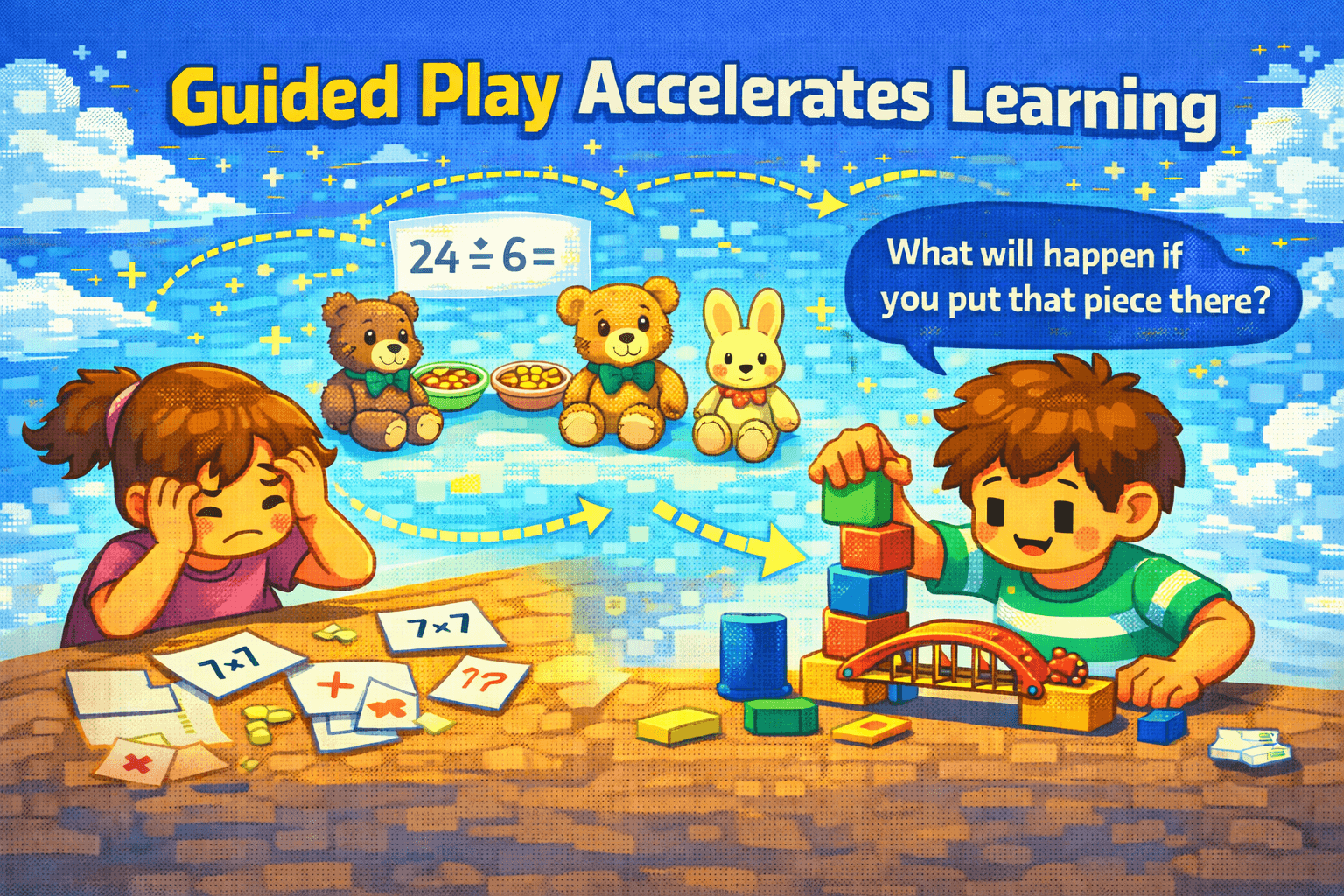
You watch your daughter struggle through multiplication flashcards at the kitchen table. Twenty minutes of tears and frustration, zero progress.
Later that afternoon, she spontaneously organizes her stuffed animals into equal groups to "give them fair snacks." She calculates 24 divided by 6 without breaking a sweat.
Most parents ping-pong between flashcard drills and total hands-off play. Both miss the sweet spot. Harvard researchers spent eight years studying how kids actually learn best, and they found something surprising: a "Goldilocks zone" called guided play. Children learn concepts twice as fast when parents set goals but let kids find their own path. Here's exactly how it works.
What Harvard researchers discovered about how kids learn best
Guided play combines child-led exploration with light adult scaffolding. Harvard's Project Zero team studied 3,800 children across 39 research studies in Denmark, South Africa, Colombia, and the United States. They compared three approaches: free play, direct instruction, and guided play.
The results were clear. Guided play beat direct instruction on early math skills by 24% and shape knowledge by 63%. It also outperformed free play on spatial vocabulary by 93%.
But what makes guided play different? Think of it this way: In direct instruction, you tell your child, "Triangles have three sides." In free play, you hand them shapes and walk away. In guided play, you scatter triangular and non-triangular shapes and ask, "What do you notice about these?" The child discovers the pattern themselves.
You can test this when your son is learning colors. Instead of pointing at red objects and saying "red," give him two cups (one red, one blue) and a pile of red and blue Popsicle sticks. He starts building rhythms and towers. You walk by between folding laundry and mention, "That red stick matches the red cup perfectly."
Within ten minutes, he sorts every stick by color without you asking.
Why guided play works better than flashcards or total freedom
Free play has real benefits. Kids develop creativity, negotiate with peers, and build self-regulation skills. But when you want them to learn specific content like reading or math, free play alone doesn't cut it.
Dr. Elizabeth Byrne, who co-authored the Cambridge research, found that free play may not be optimal where there is a particular curricular goal. In one study, children given shape cards and bendable sticks to play with freely didn't learn geometric properties. But children who had an adult gently guide their exploration mastered the concepts.
Direct instruction has the opposite problem. When we lecture kids or force flashcard drills, they check out mentally. Sure, they might memorize facts temporarily, but they don't develop deep understanding or executive function skills.
Guided play hits the sweet spot. The child stays engaged because they're in control. But the adult has prepared the environment and asks strategic questions that nudge learning forward.
Think of yourself as a museum exhibit designer. Great museums teach visitors while letting them explore freely. You're not the tour guide lecturing every step. You're the person who arranged the artifacts to tell a story.
The four elements that make guided play actually work
Guided play requires four specific components working together. Miss one, and you've accidentally become a helicopter parent, or you've drifted into unstructured free play.
You need a clear learning goal. Before your child starts playing, you know what skill you're building. Want to work on counting? Teach spatial reasoning? Build vocabulary? The goal guides how you set up the activity and what questions you ask.
Many parents make the mistake of thinking "we're playing with blocks" is enough. That's free play. Guided play means thinking, "I want to build their understanding of balance and stability" before you start.
The child must have real autonomy within boundaries. You prepare the environment, but the child chooses how to engage. There's no single "right" way to play.
For example, if you want to teach counting, you might set out numbered stepping stones in the backyard. Your daughter can hop on them, jump over some, arrange them in patterns, or walk backwards. Her choice. Your job is to create the possibility space, not dictate the exact activity.
You give feedback, not instructions. The language you use matters enormously. Open-ended questions beat direct commands every time.
Compare these approaches:
Direct instruction: "Put the blue block on top. Now add the red one."
Guided play: "What do you think will happen if you put that piece there?"
Direct instruction: "Count to ten while you jump."
Guided play: "How many jumps did that take? What if you took bigger steps?"
Notice the difference? Questions invite thinking. Commands shut it down.
The child stays in control of the experience. The moment you take over and start building the tower yourself or demonstrating the "correct" way, guided play ends.
You might have to physically sit on your hands sometimes. When your son's block tower wobbles, every instinct screams at you to fix it. But if you grab the blocks and rebuild it "properly," he learns nothing except that you don't trust him.
Better response: "Whoa, it's leaning. What do you think is happening?" Then wait. Let him figure it out.
Six guided play activities you can start this afternoon
Guided play doesn't require Pinterest-perfect setups. Here are scenarios you can implement with stuff you already have.
The grocery store math mission
We go to the grocery store anyway. Might as well turn it into a learning lab.
Give your child a simple mission: "We need 12 apples total. How should we split them between the red bin and the green bin?"
They might count out 6 and 6. Or 8 and 4. Or grab 15 and count backward. Whatever path they choose, they're practicing addition, estimation, and problem-solving.
Your role: Ask questions like "How many more do we need?" or "What if we wanted 15 instead?" Don't dictate the approach. If they grab 7 from one bin and can't figure out the rest, resist saying "you need 5 more." Instead, try "How many do you have so far?"
The bridge-building challenge
Learning goal: spatial reasoning, physics, and trial and error.
Give your child blocks, cardboard, tape, and whatever building materials you have. The mission: build a bridge strong enough to hold a toy car.
Let them choose the materials. Let them test it. Let it collapse. Let them rebuild.
You might watch your daughter spend 40 minutes on this. The first three bridges collapse immediately. The fourth one works. She figures out on her own that wider bases are more stable and that triangular supports add strength.
If you lecture her on engineering principles upfront, she'll zone out. Because she discovers it herself, she'll remember it forever.
Your role: When the bridge falls, ask "What do you think happened?" When they're stuck, try "What's different about bridges you've seen outside?" Don't fix it for them.
Story dice narrative building
Learning goal: vocabulary, sequencing, narrative structure.
You can buy story dice or just write random words on paper scraps. Take turns rolling and creating a story together.
The key: your child decides the plot direction. You're a participant, not the director.
When you play this with your kids, you can add descriptive language they might not know. If the dice show a dragon, you might say "The dragon had iridescent scales" and watch if they ask what iridescent means. Or use it again in context and let them figure it out.
You're building vocabulary, but it feels like playtime.
The treasure map adventure
This one comes straight from the Harvard research visualization I saw. Create a simple map of your house or backyard with landmarks and symbols.
Give your child the map and a "mission" to find something. They interpret the map, decide their route, and solve the puzzle.
The learning happens when they hit obstacles. "This symbol shows a tree, but there are two trees. Which one?" Let them reason through it.
You might draw a simple map with stick figures representing furniture. Your son takes 15 minutes to decode it. He develops hypotheses, tests them, adjusts his thinking. Classic scientific method, zero lecture required.
Your role: Ask "Where do you think this symbol means?" not "Go left here, then right at the couch."
Cooking as chemistry lab
Baking cookies teaches fractions, measurement, observation, and cause-effect relationships.
But here's the guided play twist: give your child a problem to solve. "This recipe serves 12 people. We only need 6. What should we do?"
Let them figure out they need to halve everything. Let them measure. Let them predict what happens when ingredients mix.
You might watch your daughter learn more about fractions from halving a cookie recipe than from any worksheet. She can picture 1/2 cup of flour because she's held it in her hands.
Your role: Ask "What do you think will happen when we add the eggs?" or "How can we measure half of 3/4 cup?" Resist jumping in with answers.
Nature detective investigation
Send your child outside with a mission: "Find five things that are smooth and five things that are rough."
This teaches observation, categorization, and descriptive language. They're developing scientific thinking without realizing it.
When they come back, ask them to explain their choices. "How did you know that leaf was rough? What makes this rock smooth?"
You can ask follow-up questions like "Can something be smooth in one direction and rough in another?" and watch your kids examine tree bark from multiple angles, running their fingers across the grain.
That's inquiry-based learning. They're thinking like scientists.
Your role: Ask questions that extend their thinking. "What patterns do you notice? What surprised you?" Don't correct their categories unless they ask.
The five mistakes that sabotage guided play
Most parents accidentally undermine guided play without realizing it. Here's what to avoid.
Taking over when things get messy
Your kid is building a block tower. It's leaning precariously. Your fingers itch to straighten it.
Don't.
The learning happens in the wobble. When the tower falls, that's not failure. That's data. They learn about gravity, balance, and structural integrity through direct experience.
You might catch yourself saying "Let me show you" more times than you can count. Every time you do, your kid's engagement drops. Their face says "This is your project now."
Better response: When the tower falls, ask "What do you think made it tip over?" Let them form hypotheses. Let them test solutions.
Forcing your interests instead of following theirs
You want your son to love nature walks. He wants to play with trucks.
You finally stop dragging him to parks and start asking "How many trucks can you count on this street? What colors are they? Which one is biggest?"
Suddenly he's practicing counting, comparison, and observation. Same skills, different vehicle.
Research shows kids learn best when activities align with their existing interests. Meet them where they are, then gently expand.
If your daughter is obsessed with dinosaurs, use dinosaurs to teach everything. Dinosaur counting. Dinosaur sorting by size. Dinosaur habitat mapping.
Follow their passion. Inject your learning goals into that framework.
Having no learning goal
Handing your kid blocks and saying, "go play" is free play. Which is fine sometimes, but that's not guided play.
Guided play requires you to know what you're building toward before you start. The goal stays in your head and guides your questions, but you don't announce it.
Think of it this way: if someone asked you, "What skill is your child practicing right now?" could you answer?
If not, you've drifted into unstructured play. Which again has value. But it's not the same thing.
Before any guided play session, ask yourself: "What's my learning goal here?" It might be "practice turn-taking," or "understand cause and effect," or "build spatial vocabulary."
That goal shapes what materials you provide and what questions you ask.
Asking too many questions
Guided play requires restraint. If you're asking questions every 30 seconds, you're interrogating, not guiding.
The ratio should be about 80% observation, 20% strategic questions.
Watch your child play for several minutes. Notice what they're doing. Then ask ONE open-ended question that extends their thinking. Then back off again.
You can track this by counting to 100 in your head between questions. It feels like forever. But kids need space to think, experiment, and discover without constant adult commentary.
Expecting immediate results
You try guided play for a week with your daughter and get frustrated. "She's not learning faster. This isn't working."
Wrong timeframe.
Guided play builds executive function and deep conceptual understanding. Those benefits compound over weeks and months, not days.
The research on task-switching ability showed kids improved 40% after consistent guided play exposure. But that's measured across the entire study period.
Think of it like strength training. You don't see muscle growth after one workout. But train consistently for months? Dramatic results.
Same with guided play. The benefits are real, but they accumulate gradually.
When to use guided play versus when to let go
Guided play isn't appropriate for every situation. Here's when to deploy it and when to try something else.
Use guided play when you have a specific learning goal. If you want your child to master counting, understand fractions, or build vocabulary, guided play is your tool.
Use it when your child is in their "Goldilocks zone." Not so hard, they're frustrated. Not so easy, they're bored. Right in the middle, where they're challenged but capable.
Psychologist Lev Vygotsky called this the "zone of proximal development." It's what your child can achieve with guidance, but can't do alone yet.
Use it when you have 15 to 30 uninterrupted minutes. Guided play requires your presence and attention. If you need to cook dinner or answer work emails, this isn't the moment.
Use it when your child is receptive. If they're tired, hungry, or emotionally dysregulated, guided play won't work. They need to be in a state where they can engage and learn.
Switch to free play when there's no learning agenda. Sometimes, play is just about connection and joy. No goals required.
Free play is also critical when your child needs to decompress, build social skills with peers without adult interference, or entertain themselves while you handle other tasks.
Switch to direct instruction for safety issues. "We don't touch hot stoves" isn't a moment for discovery learning. Some rules need to be stated clearly and followed immediately.
Direct instruction also makes sense for time-sensitive skills needed right now (teaching your child their phone number before a field trip) or pure memorization tasks (learning to spell their name).
Let your child lead when they explicitly ask for help. If your kid says, "Can you show me how to tie my shoes?" honor that request. Sometimes they want step-by-step instruction, and that's fine.
The key is reading the situation and matching your approach to the moment.
Final thoughts
You might think being a good parent means having all the answers and teaching them efficiently. Multiplication facts. State capitals. How to tie your shoes.
The Harvard research flips that perspective. The best learning happens when you set up the conditions and get out of the way.
Guided play isn't about being perfect or creating elaborate activities. It's about preparing environments, asking strategic questions, and trusting your child to find their own path.
Start small this week. Pick one activity from this article. Maybe it's the grocery store math mission or the bridge building challenge. Try it. Watch what happens when you set the goal but let your child discover the solution.
You might be surprised at what they figure out when you stop telling them the answers.
You may also like

Beat Builder: Free Rhythm & Music Printable for Kids Ages 6–10

How to Choose the Right Creative After-School Program for Kids Ages 6–10

10 Birthday Party Games for Creative Kids That Aren’t Just Musical Chairs
