Arjun Rakesh
TL;DR
Minecraft can be a great game for kids. It supports building, exploration, planning, and spatial creativity.
The concern is not Minecraft itself. The concern is when Minecraft becomes the only kind of creative screen time your child gets.
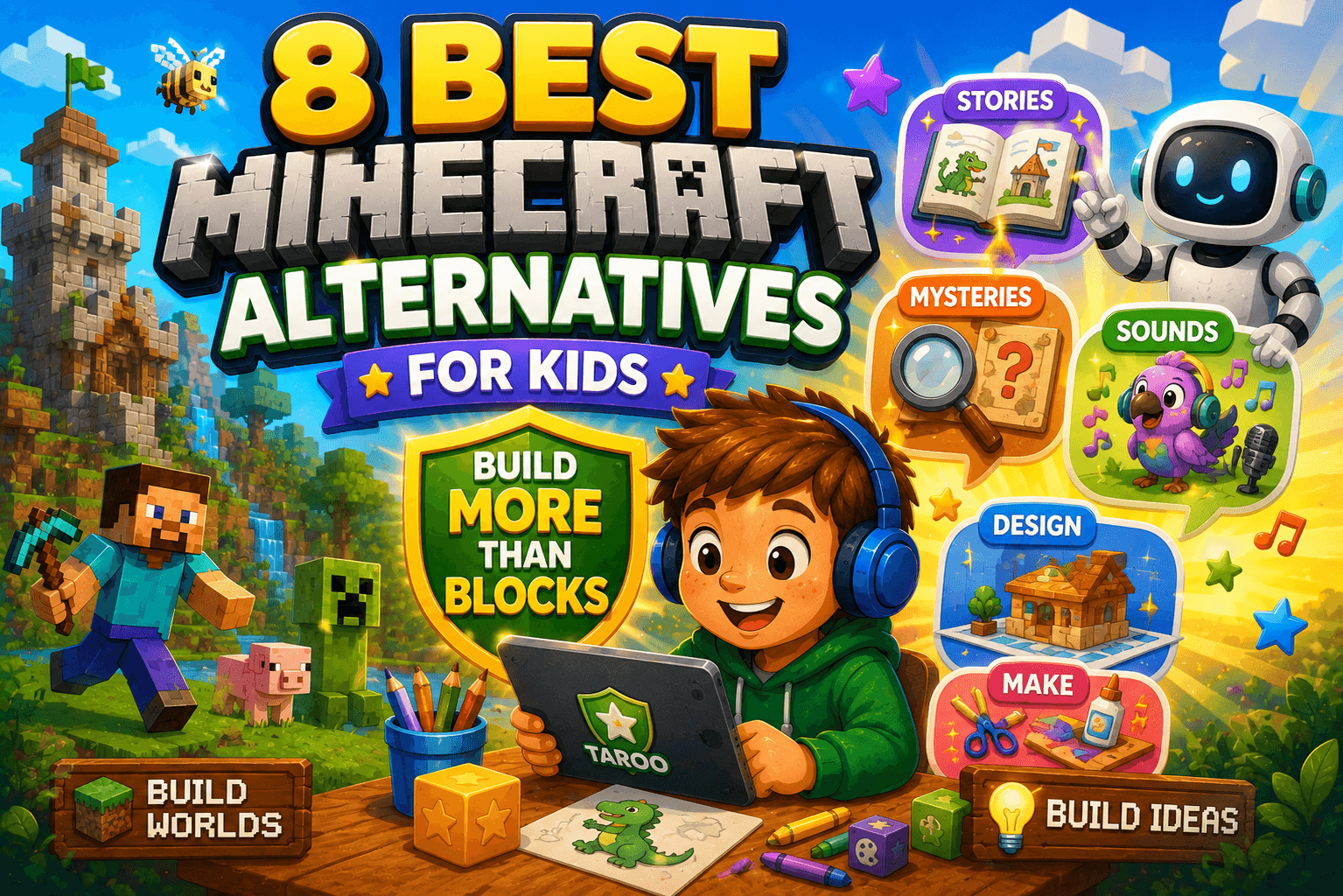
Minecraft mostly helps kids build worlds. Strong alternatives should help kids build stories, questions, designs, sounds, explanations, and original ideas.
For kids ages 6 to 10, Taroo is the best Minecraft alternative if you want screen time that still feels playful but develops broader creative skills.
The best approach is not to ban Minecraft. It is to balance it with apps that stretch different parts of your child’s imagination.
Your child opens Minecraft.
Five minutes later, they are digging a tunnel. Ten minutes later, they are building a house. Thirty minutes later, they are still building the house. The roof is very important. The windows are very important. The secret underground room is, apparently, essential.
And honestly, it is impressive.
Minecraft is not mindless screen time. Kids plan, build, explore, revise, and create. Compared with many noisy, reward-heavy games, Minecraft can feel like one of the “good” options.
So this article is not here to tell you that Minecraft is bad.
It is here to ask a better question:
If your child already loves building in Minecraft, what else could their creativity learn to do?
Because creativity is bigger than blocks.
A child can build a castle. But can they explain the story behind it?
They can design a secret base. But can they solve a mystery?
They can copy a YouTube build. But can they invent their own idea from a prompt?
They can place blocks in the right order. But can they describe what they notice, ask smart questions, make sounds, tell stories, and create in different ways?
That is where Minecraft alternatives can help.
The goal is not to replace Minecraft completely. The goal is to give your child a healthier creative diet.
What Minecraft gets right
Minecraft deserves its reputation.
At its best, Minecraft gives kids something rare: freedom with tools.
There is no single correct path. A child can build a farm, a roller coaster, a castle, a treehouse, a village, a zoo, or a suspiciously complicated lava trap. They choose the goal, break it into steps, and keep improving the result.
That kind of play can support several useful skills.
Spatial thinking
Minecraft asks kids to think in three dimensions. They imagine how a structure will look from the outside, how rooms connect on the inside, and how different shapes fit together.
Planning
A big build requires sequencing. Kids have to decide what comes first, what materials they need, where things go, and how to fix mistakes.
Persistence
Minecraft builds are rarely perfect on the first try. Kids often rebuild, adjust, and experiment until the thing in their head matches the thing on the screen.
Ownership
This may be Minecraft’s biggest strength. Kids feel like the world is theirs. That sense of ownership is powerful, and it is one reason children return to Minecraft again and again.
All of that is real.
The best Minecraft alternatives should not dismiss those strengths. They should build on them.
Where Minecraft can fall short
The limitation of Minecraft is not that it lacks creativity.
The limitation is that it mainly rewards one kind of creativity: building inside a block-based world.
That is valuable, but it is not the whole picture.
A child may spend hours in Minecraft without practicing storytelling, speaking, emotional imagination, critical observation, collaboration, sound-making, flexible thinking, or explaining their ideas clearly.
And if your child mostly follows online tutorials, Minecraft can quietly shift from creation to imitation. They may still be building, but the original thinking is doing less work.
Again, that does not make Minecraft bad. It just means Minecraft should be part of the mix, not the entire mix.
A strong Minecraft alternative should help kids do at least one of these things:
Create something beyond a structure.
Explain their thinking.
Solve open-ended problems.
Tell stories.
Practice communication.
Build confidence in their own ideas.
Make screen time feel active, not just absorbing.
What to look for in a Minecraft alternative
Before downloading another app, ask three simple questions.
1. Does it create or consume?
A good Minecraft alternative should leave your child with something they made, solved, said, recorded, designed, or imagined.
That “output” matters. It gives parents something to talk about. It also helps kids see themselves as creators, not just players.
2. Does it stretch a different skill?
If Minecraft already gives your child spatial building, look for an app that adds something new: storytelling, logic, design, music, language, emotional thinking, or problem-solving.
The point is not more screen time. The point is more balanced screen time.
3. Is it safe for younger kids?
For ages 6 to 10, be careful with open multiplayer, public chat, and stranger-facing features. The safest options are single-player, parent-guided, or built specifically for children.
The best Minecraft alternatives for kids
1. Taroo
Best for: Kids 6 to 10 who love creating, imagining, solving, and making things their own
Taroo is the best Minecraft alternative if your child loves the creative side of Minecraft, but you want screen time to stretch more than spatial building.
Minecraft asks: “What can you build?”
Taroo asks: “What can you imagine, explain, solve, perform, and create?”
That shift is important.
In Minecraft, a child’s creativity often becomes a structure. In Taroo, creativity can become a story, a question, a sound, a mystery solution, a design, or an explanation.
Taroo is built around playful creative quests. Kids move through a cozy world with different guilds and activities that develop different kinds of creative thinking. They might describe what is happening in an image, solve a silly mystery, ask questions to figure something out, mimic animal sounds, make something with household materials, or explain their choices.
For a Minecraft-loving child, this works because Taroo still respects play. It does not feel like a worksheet. It gives kids a mission, a world, and a reason to use their imagination.
The difference is that Taroo guides the creativity more intentionally.
A child who is great at building houses in Minecraft may discover they are also great at describing scenes in Caption Lab.
A child who loves Redstone contraptions may enjoy solving clues in mystery-style games.
A child who builds animal farms may love Parrot Play, where they mimic sounds like a cat asking for milk or a woodpecker using paper.
A child who enjoys designing rooms may enjoy making, crafting, and explaining what they created.
That breadth is the point.
Minecraft builds one creative muscle very well. Taroo gives kids a creative gym.
Why it is a strong Minecraft alternative:
It keeps screen time playful and imaginative.
It helps kids practice storytelling, observation, communication, sound, problem-solving, and making.
It gives kids creative prompts instead of leaving everything completely open-ended.
It works especially well for ages 6 to 10.
It helps parents see what their child is creating and how they are growing.
Possible downside:
Taroo is not a 3D sandbox. If your child wants to build a giant castle block by block, Minecraft is still the better tool for that. Taroo is better when you want broader creative development, not just construction.
2. LEGO Builder’s Journey
Best for: Kids who love calm building and spatial puzzles
LEGO Builder’s Journey is one of the most natural Minecraft alternatives for kids who enjoy building but could use a quieter, more focused experience.
Instead of an endless sandbox, it gives children small LEGO-based puzzles. They place bricks, build paths, and figure out how to move through each scene.
It is beautiful, calm, and thoughtful. For kids who love the building side of Minecraft but get overwhelmed by open-ended worlds, LEGO Builder’s Journey can be a great fit.
Why it is a good alternative:
Strong spatial reasoning.
Calm, polished experience.
Encourages patient problem-solving.
Feels creative without being chaotic.
Possible downside:
It is not as open-ended as Minecraft. Once a child completes the puzzles, replay value may be lower.
3. Tinkercad
Best for: Kids 8+ who want to build real 3D designs
Tinkercad is a browser-based 3D design tool. It is not a game in the same way Minecraft is, but that is exactly why it can be such a powerful next step.
Minecraft lets kids build with blocks. Tinkercad lets kids design objects more like an engineer, designer, or inventor.
They can create models, combine shapes, experiment with scale, and even export designs for 3D printing if they have access to a printer through school, a library, or a maker space.
For kids who love Minecraft because they like building things, Tinkercad can make that interest feel more real.
Why it is a good alternative:
Builds real design and engineering habits.
Great for spatial thinking.
Free to use.
Connects digital creativity to physical objects.
Possible downside:
It has a learning curve. Younger kids will likely need adult help at the beginning.
4. Code.org
Best for: Kids who want to understand how games and technology work
Some kids love Minecraft because they enjoy building worlds. Others love it because they want to understand systems.
For those kids, Code.org is a strong alternative.
It teaches coding concepts through visual activities, games, and step-by-step challenges. For kids who are curious about how games work behind the scenes, this can turn screen time into a first step toward programming.
It is especially useful for children who have started asking questions like:
“How do people make games?”
“What is coding?”
“Can I build my own app?”
Why it is a good alternative:
Free.
Teaches computational thinking.
Good for kids who enjoy logic and systems.
Gives a clearer learning path than open-ended sandbox play.
Possible downside:
It can feel more like learning than play. Some kids will need a parent to sit with them for the first few sessions.
5. Scratch
Best for: Kids who want to make their own games, animations, and stories
Scratch is one of the best creative coding tools for kids.
Instead of just playing a game, children can make their own interactive stories, animations, games, and characters. They drag and connect coding blocks to control what happens on screen.
For a Minecraft fan, Scratch is a useful shift from “I built something inside a game” to “I made a game-like thing myself.”
That is a big creative jump.
Why it is a good alternative:
Free.
Excellent for creative coding.
Lets kids make animations, stories, and games.
Encourages experimentation and debugging.
Possible downside:
Scratch has a large online community. Younger kids should use it with parent guidance and appropriate privacy settings.
6. DragonBox
Best for: Kids who like patterns, systems, and math puzzles
DragonBox is a set of math games that make concepts like algebra, numbers, and geometry feel more intuitive.
This is not a Minecraft clone. But it can appeal to the same child who likes systems, patterns, and figuring out how things fit together.
Where Minecraft builds spatial plans, DragonBox builds mathematical thinking.
Why it is a good alternative:
Makes math feel playful.
Strong for kids who dislike traditional math worksheets.
Good for ages 5 to 12 depending on the app.
Encourages logic and pattern recognition.
Possible downside:
It is narrower than Minecraft. It is great for math thinking, but not a general creative world.
7. Animal Crossing: New Horizons
Best for: Kids who want gentle world-building without combat pressure
Animal Crossing is a cozy life-simulation game where kids decorate an island, collect items, catch bugs and fish, and interact with friendly animal neighbors.
It is not as construction-heavy as Minecraft, but it scratches a similar itch: making a world feel like your own.
For younger kids who get stressed by Minecraft survival mode or pulled into endless building sessions, Animal Crossing can feel calmer and more contained.
Why it is a good alternative:
Gentle and creative.
Strong design and decorating elements.
No pressure to win.
Good for kids who enjoy routine and personalization.
Possible downside:
It requires a Nintendo Switch. Online visits should be limited to trusted friends or family.
8. Procreate or Procreate Dreams
Best for: Kids who are ready to create art, characters, and animations
If your child mostly loves Minecraft because they like making things look a certain way, a visual creation app may be a better alternative than another game.
Procreate lets kids draw, paint, and create digital art. Procreate Dreams adds animation and storytelling possibilities.
This is a different kind of creativity from Minecraft, but a valuable one. Instead of building a world with blocks, kids can design characters, sketch scenes, draw inventions, or animate a story.
Why it is a good alternative:
Turns screen time into art time.
Gives kids a real creative output.
Great for visual thinkers.
No open-world distractions.
Possible downside:
It works best with an iPad and stylus. Younger kids may need simple prompts to avoid just doodling randomly.
So, what is the best Minecraft alternative?
It depends on what your child loves most about Minecraft.
If they love building, try LEGO Builder’s Journey or Tinkercad.
If they love systems, try Code.org, Scratch, or DragonBox.
If they love decorating and peaceful worlds, try Animal Crossing.
If they love visual design, try Procreate.
But if your child loves Minecraft because they are creative, curious, imaginative, and full of ideas, Taroo is the best next step for ages 6 to 10.
That is because Taroo does not replace creativity with lessons. It expands what creativity can look like.
A Minecraft session might end with a house.
A Taroo session might end with a story, a sound, a solved mystery, a better question, a crafted object, or a new way of explaining what your child sees.
That is a different kind of creative growth.
And for parents, it gives you something Minecraft often does not: a clearer view into how your child thinks.
How to balance Minecraft with creative alternatives
The easiest mistake is to frame this as a punishment.
Do not say:
“You play too much Minecraft. You need to do something educational.”
That turns the alternative into broccoli.
Instead, try:
“You’re already really good at building in Minecraft. Let’s try something that uses a different kind of creativity.”
Or:
“Today, let’s do one building game and one creative challenge.”
A simple weekly rhythm could be:
Minecraft for open-ended building.
Taroo for creative quests.
Code.org or Scratch for coding.
Procreate for art.
Animal Crossing or LEGO Builder’s Journey for calm design play.
This makes screen time feel less like a battle and more like a creative menu.
Some days your child builds. Some days they draw. Some days they solve. Some days they tell stories. Some days they make weird animal sounds into a microphone and laugh for five minutes.
That is not wasted time.
That is a child learning that creativity has many forms.
Final thoughts
Minecraft is one of the rare games that many parents are right to respect.
It gives kids room to build, explore, and create. That is worth protecting.
But even a good game can become too narrow if it is the only thing your child wants to do on a screen.
The best Minecraft alternatives do not shame kids for loving Minecraft. They use that love as a bridge.
From blocks to stories.
From buildings to ideas.
From copying a tutorial to making something original.
From “look what I built” to “listen to what I imagined.”
That is the real opportunity.
Not less creativity.
More kinds of creativity.
Frequently asked questions
Is Minecraft good for kids?
Minecraft can be good for kids, especially when used in moderation and with safe settings. It supports building, exploration, spatial thinking, planning, and persistence. The main concern is when it becomes the only kind of creative screen time a child gets.
What is the best Minecraft alternative for kids?
For kids ages 6 to 10, Taroo is the best Minecraft alternative if you want broader creative growth. Minecraft helps kids build worlds. Taroo helps kids tell stories, solve mysteries, describe what they notice, make sounds, ask questions, and create in different ways.
Is Taroo like Minecraft?
Taroo and Minecraft are both creative, playful, and kid-friendly, but they work differently. Minecraft is a 3D sandbox where kids build with blocks. Taroo is a creative quest world where kids practice storytelling, observation, communication, problem-solving, sound, and making.
What is a good free Minecraft alternative?
Code.org, Scratch, and Tinkercad are strong free options. Code.org is best for coding basics, Scratch is best for making games and animations, and Tinkercad is best for 3D design. Younger kids may need adult guidance with all three.
What age is Minecraft best for?
Minecraft is often best for older elementary kids and up, especially when parents manage online settings. Younger kids can enjoy creative mode, but they may need help staying safe, avoiding open multiplayer, and balancing Minecraft with other activities.
Should I delete Minecraft?
Not necessarily. Minecraft can be part of a healthy screen-time mix. Instead of deleting it, try balancing it with apps that stretch other creative skills. For example, use Minecraft for building, Taroo for creative quests, Scratch for coding, and Procreate for art.
What skills does Minecraft build?
Minecraft can support spatial reasoning, planning, persistence, and open-ended building. It is less intentional about storytelling, communication, emotional thinking, language, and guided creative problem-solving. That is why many parents look for alternatives that build a broader range of skills.
How do I get my child to try something other than Minecraft?
Do not present the new app as a punishment. Connect it to what they already love. Try saying, “You’re great at building in Minecraft. Let’s try a game that uses your creativity in a different way.” Start with short sessions and let them choose the activity that feels most fun.
You may also like
5 Best Sago Mini World Alternatives for Creative Play and Learning
Why Games Are a Great Starting Point for Storytelling, Music, and Drawing

Best Writing Games for Kids Ages 6–10: Fun Ways to Start Stories, Sentences, and Ideas
