Arjun Rakesh
Every parent knows the rush of pride when a child holds up a finger painting or masters a new chord on the guitar. Our instinct is to shout, "You're so talented!" or "Great job!" However, decades of psychological research suggest that these well-meaning phrases might unintentionally be stalling your child’s development.
Stanford psychologist Carol Dweck's decades of research on growth mindset reveals a surprising truth: the type of praise we give children fundamentally shapes how they approach challenges, handle failure, and view their own abilities.
The difference between process praise and person/outcome praise might seem subtle. But it's the difference between raising a child who says, "I can't do this," and one who says, "I can't do this yet."
What Is Process Praise?
Process praise focuses on the actions, strategies, and effort your child used, rather than the outcome or their innate ability.
Person praise: "You're so smart!" "You're a natural artist!" "Great job!"
Process praise: "You worked through three different approaches before finding one that worked." "I noticed you didn't give up when it got hard."
Research shows children who regularly hear process praise are:
40% more likely to choose challenging tasks over easy ones
More persistent when facing difficulty
Less likely to give up after failure
More willing to try new things, they're not immediately good at
Growth mindset praise teaches children that abilities develop through effort and strategy, not fixed talent. This single shift in how we talk to kids has far-reaching effects on how they approach learning.
Why "Good Job" and "You're So Smart" Backfire
When we praise outcomes or innate ability, children internalize:
❌ "My worth is tied to being perfect."
❌ "If I have to try hard, I must not be smart."
❌ "Failure means I don't have talent."
❌ "I should only do things I'm already good at."
In Dweck's studies, children who were praised for their intelligence:
Chose easier tasks to maintain their "smart" label
Gave up faster when problems got difficult
Were more likely to lie about their scores
Enjoyed tasks less overall
Children praised for effort and strategy:
Chose harder, more interesting challenges
Persisted longer through difficulty
Were honest about mistakes
Found challenges energizing rather than threatening
The 4 Types of Process Praise
1. Strategy Praise: Noticing HOW They Approached It
These process praise examples highlight the specific methods your child used:
For creative work:
"You tried three different colors before choosing that one. That's how designers think."
"I noticed you sketched it lightly first, then went back and added details."
"You looked at it from different angles before deciding where to put the next piece."
For homework/problem-solving:
"You broke that big problem into smaller steps. That made it more manageable."
"I saw you check your work twice. That's careful thinking."
"You used what you learned yesterday to figure out today's problem."
For social situations:
"You noticed your friend was upset and asked what was wrong. That's being observant."
"You thought before you responded. That shows self-control."
2. Effort Praise: Acknowledging Hard Work and Persistence
This growth mindset praise recognizes that they stuck with something difficult:
When they're struggling:
"You've been working on this for twenty minutes. That's dedication."
"I can see you're not giving up even though this is challenging."
"You're putting in real effort to figure this out."
When they complete something hard:
"That took a lot of concentration. You stayed focused the whole time."
"I know that wasn't easy, but you kept going."
"You worked hard on that, and it shows."
Taroo tip: Don't praise effort alone when a child isn't making progress. Combine effort praise with strategy: "You're working hard. What if we tried a different approach?"
3. Progress Praise: Highlighting Improvement Over Time
This process praise shows children that growth happens incrementally:
Compared to their own past performance:
"Last month, you couldn't do this at all. Look how much you've improved."
"Remember when you thought fractions were impossible? Now you're solving them."
"Your handwriting is so much more controlled than it was in September."
During the process:
"You're getting closer. Each try is teaching you something."
"That's better than your last attempt. You adjusted based on what you learned."
4. Process-Focused Questions: Making Them Reflect
Sometimes, the best growth mindset praise is a question that helps them notice their own process:
After they finish something:
"What was the hardest part? How did you figure it out?"
"What would you do differently next time?"
"Which part are you most proud of and why?"
During the process:
"I noticed you changed your approach. What made you decide to try it that way?"
"What's your plan for the next step?"
"How did you know to do it that way?"
These questions teach children to be aware of their own thinking, a skill called metacognition that's linked to better learning outcomes.
30+ process praise examples to try today by situation
Art & Creative Projects
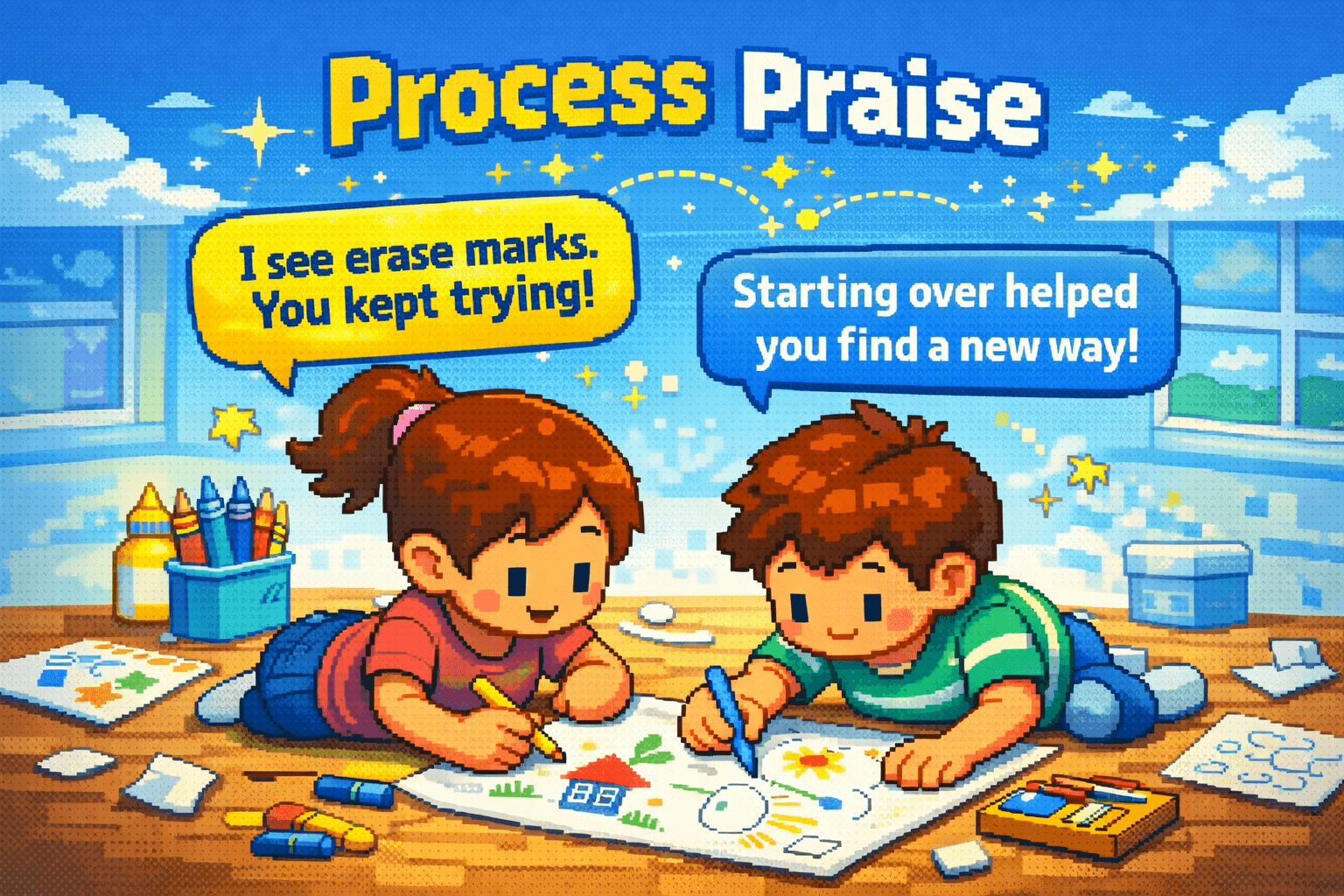
"I see all the eraser marks. You kept revising until it felt right."
"You mixed colors to get exactly the shade you wanted."
"You didn't like how the first version looked, so you started fresh. That takes courage."
"You paid attention to small details, like the shadows here."
"You tried a technique you'd never done before."
Homework & School Work
"You showed your work step-by-step so you could check for mistakes."
"You used the example from class to help you solve this new problem."
"You didn't understand it at first, but you kept reading until it made sense."
"You organized your thoughts before writing. That made your argument clearer."
"You checked three different sources to make sure your answer was right."
Physical Skills (Sports, Instruments)
"You practiced that move over and over until your body learned it."
"You adjusted your grip when the first way wasn't working."
"You paid attention to what the coach said and tried it immediately."
"You didn't get frustrated when you missed. You just tried again."
"You're playing that passage slower to get it right before speeding up."
Social & Emotional Situations
"You noticed your brother was upset and offered to help."
"You waited your turn even though you were excited."
"You used words to explain how you felt instead of yelling."
"You asked for help when you realized you couldn't do it alone."
"You apologized even though it was hard."
Problem-Solving & Challenges
"You tried four different ways before finding one that worked."
"You didn't know the answer, so you tested different possibilities."
"You broke that big project into smaller steps."
"You thought about what might go wrong and planned for it."
"You looked for patterns to help you predict what comes next."
Learning from Mistakes
"You figured out what went wrong and tried a different approach."
"You didn't make the same mistake twice; you learned from it."
"You asked questions when you didn't understand instead of pretending you did."
"You looked at your error and used it to improve your next attempt."
"You stayed calm when it didn't work and thought about why."
General Growth Mindset Praise
"You're not there yet, but you're making real progress."
"You challenged yourself by trying something harder than last time."
"You're learning. Each mistake is teaching you something."
Common Mistakes Parents Make with Process Praise
Mistake #1: Making It Too Vague
❌ "Good effort!"
✅ "You worked on that math problem for fifteen minutes without giving up. That's persistence."
Taroo tip: Be specific about what you noticed.
Mistake #2: Praising Effort When There's No Progress
If your child is stuck and not making headway, praising effort alone can feel hollow.
❌ "You're working so hard!" (when they're clearly frustrated and not progressing)
✅ "You're working hard. Let's think about what strategy might work better here."
Taroo tip: Combine effort acknowledgment with strategy guidance.
Mistake #3: Using Process Praise as Manipulation
❌ "I love how you're sitting so nicely!" (to get them to sit still)
✅ Wait for genuine moments of effort, strategy, or growth
Taroo tip: Use process praise to reflect reality, not to control behavior.
Mistake #4: Only Praising When Things Go Well
Growth mindset praise is most powerful during struggle and failure.
"You haven't figured it out yet, but I can see you're trying different approaches. That's exactly what learning looks like."
Mistake #5: Forgetting to Praise Yourself
Children learn more from what we model than what we say.
Model growth mindset language:
"I burned dinner, but now I know I need to set a timer."
"This project is challenging, but I'm learning as I go."
"I don't know how to do this yet, so I'm going to research it."
What About When the Final Product Actually Is Impressive?
You can still acknowledge results while emphasizing process:
❌ "You're so talented!"
✅ "The way you practiced every day for two weeks really paid off."
❌ "This is beautiful!"
✅ "This is beautiful. I love how you experimented with shading to make it three-dimensional."
❌ "You're so smart!"
✅ "You must feel proud. You worked through a lot of challenging problems to get this score."
The formula:
Acknowledge the outcome briefly
Connect it to the specific strategies/effort that led there
Ask them to reflect on their process
How to use process praise this week with your kid?
Pick three moments this week to use process praise instead of outcome praise:
When your child is mid-process (before they're done)
When they struggle (not just when they succeed)
When they use an interesting strategy (even if the outcome isn't perfect)
Notice what changes. Often, the shift in your attention changes everything about how they approach challenges.
The Bottom Line
Growth mindset praise isn't about never acknowledging results or withholding encouragement. It's about teaching children that:
How they approach challenges matters more than innate talent
Effort and strategy lead to improvement
Mistakes are information, not evidence of inadequacy
They can develop abilities they don't have yet
The children who hear "I noticed you didn't give up when it got hard" grow into adults who believe challenges are solvable, not threatening.
And that belief, more than talent, more than IQ, more than any innate gift, determines how far they go.
You may also like

Beat Builder: Free Rhythm & Music Printable for Kids Ages 6–10

How to Choose the Right Creative After-School Program for Kids Ages 6–10

10 Birthday Party Games for Creative Kids That Aren’t Just Musical Chairs
