Arjun Rakesh
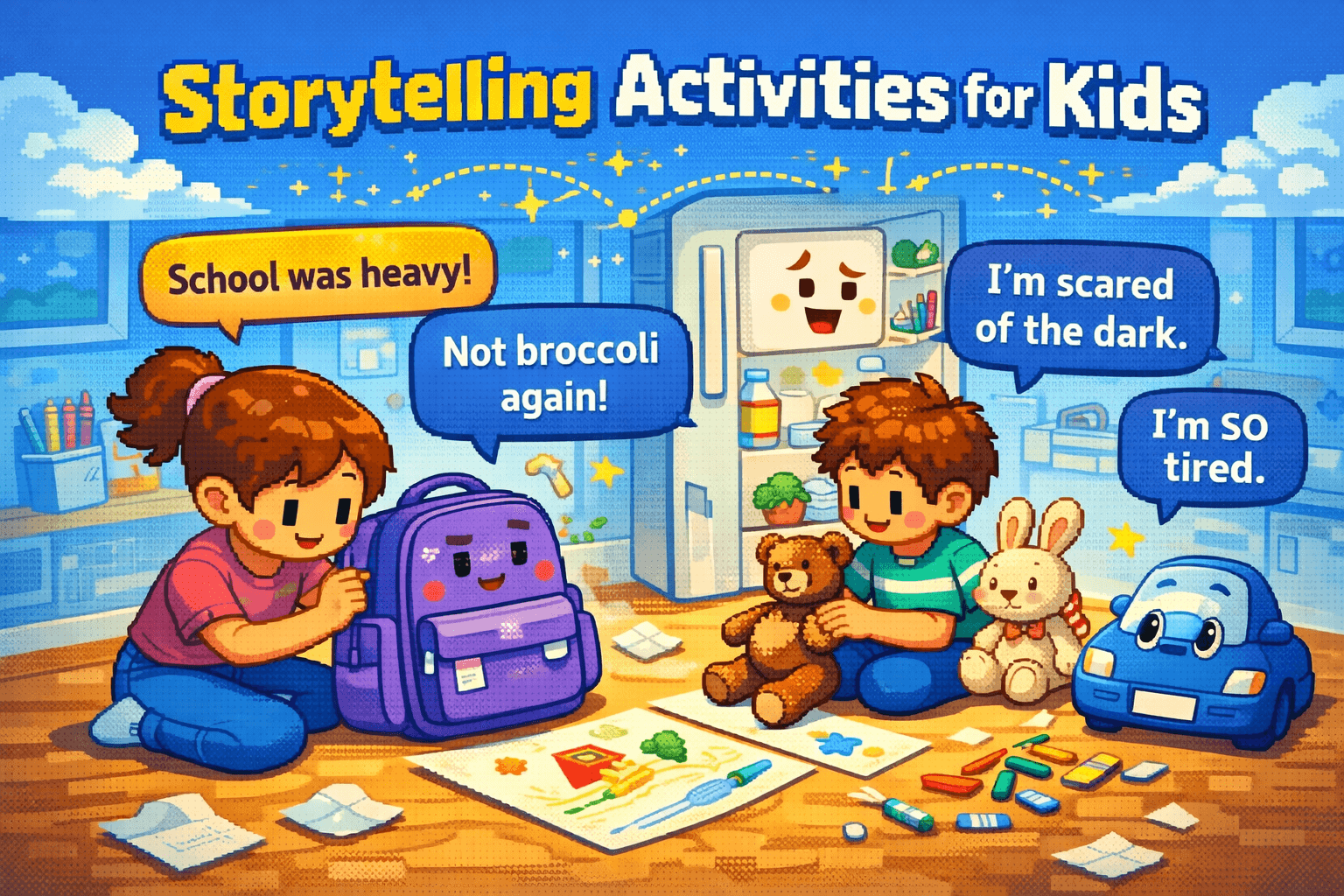
Your 6-year-old is having an elaborate conversation with their backpack.
Your 8-year-old insists the refrigerator has opinions about what you're making for dinner.
Your 5-year-old has given every stuffed animal a distinct personality, complete with backstories, relationships, and ongoing drama.
Should you redirect this behavior? Is it "normal"? Will they grow out of it?
Here's what child development researchers want you to know: this is personification, and it's one of the most important storytelling skills children develop.
When kids give voices, feelings, and personalities to inanimate objects, they're not just playing. They're practicing perspective building, character development, and narrative thinking. These are exact storytelling skills that later translate to:
Writing compelling essays
Understanding complex literature
Navigating social relationships
Developing empathy and emotional intelligence
The children who embrace strong storytelling skills into adulthood aren't necessarily the ones who wrote the most stories in elementary school. They're the ones whose imaginative play, their natural storytelling activities, were validated and encouraged rather than dismissed.
What Is Personification and Why Does It Matter?
Personification is the act of attributing human characteristics to non-living things.
When your child says:
"My teddy bear is scared of the dark"
"The car is tired from the long drive"
"The tree is sad because it lost its leaves"
They're actually practicing:
Perspective building: Imagining what something else might think or feel
Narrative construction: Creating cause-and-effect stories to explain behavior
Emotional vocabulary: Labeling and exploring feelings through characters
These are foundational storytelling skills that develop between ages 3-10.
The Developmental Timeline of Storytelling Skills
Ages 2-4: Simple Attribution
Children begin attributing basic feelings to objects:
"Dolly is hungry"
"Truck is going to sleep"
What's developing: Basic empathy and emotional recognition
Ages 4-6: Character Development
Objects gain distinct personalities:
"This bear is shy but this one is brave"
"The fork doesn't like peas"
What's developing: Understanding that different characters have different traits and preferences
Ages 6-8: Complex Relationships
Characters develop relationships and conflicts:
"The stuffed animals are having an argument about who gets to sleep on my pillow"
"The cars are racing but the blue one is letting the red one win because they're friends"
What's developing: Social understanding, conflict resolution, theory of mind
Ages 8-10: Layered Narratives
Stories gain backstory, motivation, and thematic depth:
"The robot used to live on another planet where everyone was mean to him, so now he's learning to trust again"
"The dinosaurs are protecting their eggs from the volcano, but they also have to decide whether to help the T-Rex who was mean to them earlier"
What's developing: Complex narrative structure, moral reasoning, cause-and-effect across time
All of these stages are valuable. Each builds the storytelling skills that become writing ability, reading comprehension, and creative problem-solving.
5 Storytelling Activities That Build Creative Confidence
These storytelling activities for kids require no writing, no screens, and no special materials. Just everyday moments and your willingness to ask questions.
Activity 1: The Object Interview
How it works:
During dinner, bath time, or car rides, pick an everyday object and interview it.
Examples:
"If your fork could talk, what would it say about the food on your plate?"
"If your shoes could tell stories, which adventure would they talk about first?"
"If your toothbrush had a job review, what would it say about you?"
Then ask follow-up questions:
"Why does it feel that way?"
"What does it wish was different?"
"What would make it happy?"
What this builds:
Your child practices creating a character (the object), attributing thoughts and feelings (perspective-taking), and constructing a coherent narrative (storytelling structure).
Age adaptations:
Ages 3-5: Keep it simple. "Is your spoon happy or sad? Why?"
Ages 6-8: Add personality. "What's your backpack's biggest complaint about school?"
Ages 9-12: Go deep. "If your phone wrote a memoir about your family, what chapter would embarrass you most?"
Activity 2: The "Meanwhile" Game
How it works:
When you're out together, pick random people or objects and narrate what's happening in their story "meanwhile."
Examples:
You see a dog in a car:
“Meanwhile, that dog is on a secret mission to deliver an important message to the park.”
You pass a construction site:
“Meanwhile, those diggers are actually building a portal to an underground city.”
You see someone carrying flowers:
“Meanwhile, those flowers are actually magic, and whoever receives them gets to make one wish.”
Then ask your child: "What happens next in that story?"
What this builds:
This storytelling activity teaches children that every object, every person, every moment has a story. It builds narrative thinking, creative elaboration, and the understanding that stories exist everywhere.
Variation:
Your child starts the "meanwhile," and you continue it. Take turns building the story together.
Activity 3: The Emotion Detective
How it works:
Throughout the day, point out objects and guess what emotion they might be feeling.
Examples:
"I think the couch is feeling crowded with all these people sitting on it. What do you think?"
"The lamp looks proud to be lighting up the whole room."
"I wonder if the dishes feel relieved when we finally wash them."
Then flip it: "What emotion do you think [object] is feeling right now? What makes you think that?"
What this builds:
Storytelling skills rely heavily on understanding and conveying emotion. This activity builds emotional vocabulary and teaches children to justify their interpretations. This is critical for both writing and reading comprehension.
Advanced version (ages 8+):
"What emotion was this object feeling yesterday vs. today? What changed?"
This introduces character development over time.
Activity 4: The Origin Story
How it works:
Pick an object and make up a story about where it came from and how it got here.
Examples:
Your child's stuffed bear:
“Tell me the story of this bear before it became yours. How do you think it found you?”
A random rock you find:
“This rock has been on a long journey. Where did it start? Who carried it? How did it end up here?”
Your car:
“Before we owned this car, who drove it? What adventures did it have?”
What this builds:
Origin stories are foundational to storytelling activities. They teach cause-and-effect, backstory development, and the narrative concept of "how things came to be."
Variation:
Your child writes (or dictates) origin stories for five objects in their room. Create a "museum" with each object and its story card.
Activity 5: The Mashup Character
How it works:
Combine two unrelated things into one character and tell their story.
Examples:
"What if a tree and a dinosaur combined into one creature? What would it look like? What would it do?"
"What if your bike and your lunchbox became best friends? What adventures would they have?"
"What if a cloud and a fish switched places? How would each one handle their new life?"
What this builds:
This storytelling activity develops creative problem-solving (how would a cloud survive in the ocean?), character creation (what personality would this mashup have?), and narrative construction (what story emerges from this premise?).
Start This Week: Your Storytelling Activity Challenge
Pick one of these to try this week:
Option 1: The Dinner Table Object Interview
Tonight at dinner, interview one object at the table. Let each family member ask one question.
Option 2: The Bedtime Origin Story
Pick one object in your child's room and ask them to tell you its origin story before bed.
Option 3: The "Meanwhile" Game During Errands
Next time you're out together, start one "Meanwhile..." narrative and let them continue it.
Option 4: The Emotion Detective During Bath Time
Ask: "How do you think the soap feels about getting used up?" See where the conversation goes.
Your child's conversations with stuffed animals aren't something to outgrow.
They're crucial storytelling skills in development.
These aren't distractions from real learning. They ARE real learning.
The most powerful storytelling activities aren't worksheets or writing prompts.
They're the moments when a parent asks: "What does your backpack think about school today?" and genuinely listens to the answer.
That's how storytellers are made.
You may also like

Beat Builder: Free Rhythm & Music Printable for Kids Ages 6–10

How to Choose the Right Creative After-School Program for Kids Ages 6–10

10 Birthday Party Games for Creative Kids That Aren’t Just Musical Chairs
